
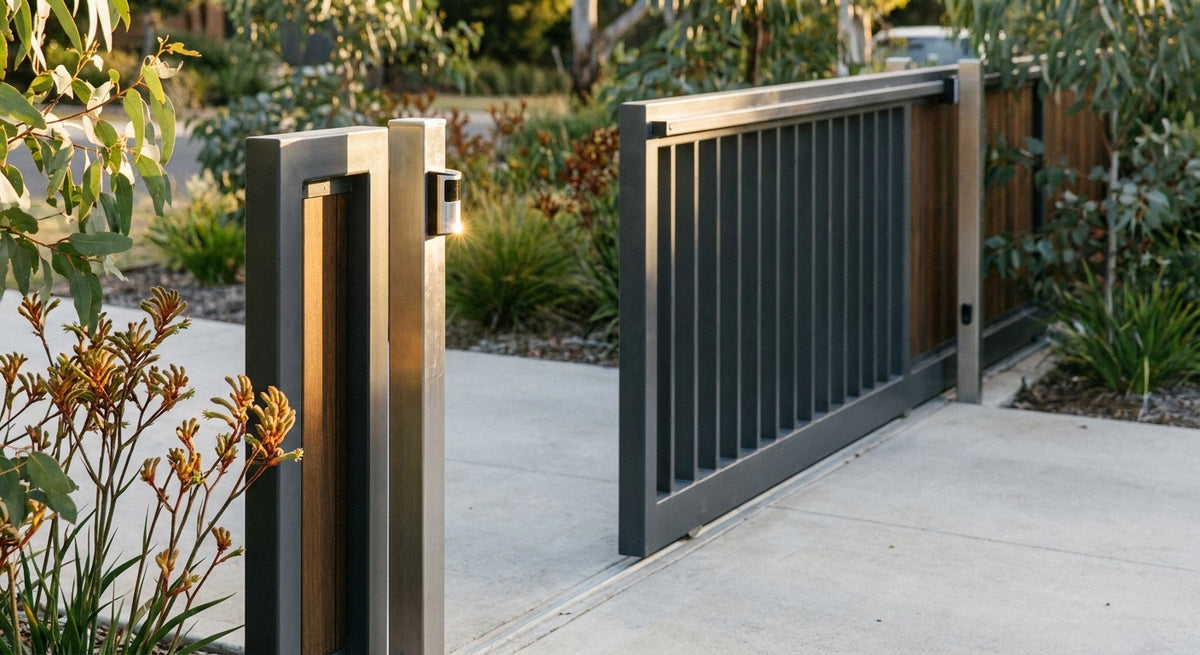
Why Safety Sensors Are Non-Negotiable on Automatic Gates
An automatic gate is a heavy, high-force machine. Without sensors, it has no way to detect a person, child, pet, or object in its path. This article explains what Australian law requires, how different sensor types work, and how to choose the right one for your gate.
Sensor Placement: Getting It Right for Sliding and Swing Gates
Installing sensors is only half the job. Placing them correctly is what actually prevents injuries. Incorrect placement can leave crushing and shearing hazards completely unprotected, even when sensors are physically present on the gate.
Sliding Gates
For sliding gates, sensors should be mounted at a height of 400 to 600mm from ground level. This range covers the centre of mass of most pedestrians, including small children, and aligns with the typical entrapment zones where a sliding gate meets the post or fence line. A single pair of sensors positioned at this height is the standard configuration. In some cases, a sensor to protect the gate return area is also worth considering, especially in schools etc where pedestrian can be in the gate track area.
Swing Gates
Swing gates are more complex. Because the gate leaf travels through an arc, hazards exist in both the opening and closing directions. A single pair of sensors is insufficient and non-compliant. Two pairs of sensors are required: one pair positioned at the open arc position and one pair at the close arc position.
Picture a top-down view of a double swing gate. Each leaf sweeps through a quarter-circle arc. Sensors at the bottom of the arc (near the closed position) protect against entrapment as the gate closes. Sensors at the top of the arc (near the fully open position) protect against entrapment as the gate opens.
Any point where a person could be trapped between moving and fixed parts needs protection.
The Three Wiring Configurations Explained
Safety sensors in Australia are available in three main wiring configurations, plus a newer fully wireless option. Each has distinct advantages depending on your installation.
Fully Hardwired
Both the transmitter and receiver are wired directly to the motor controller. This is the most reliable and tamper-resistant configuration, best suited to new installations where cable trenching across the driveway is feasible during construction. There are no batteries to replace and no wireless interference concerns.
Hardwired with Battery-Powered Opposite Side
One side is hardwired to the motor controller, while the opposite side runs on battery power and communicates wirelessly. The FAAC XP20 is a prime example of this configuration. It eliminates the need to trench a cable across the driveway, making it the preferred option for retrofitting sensors onto existing gates. Battery life on the wireless side is approximately 3 to 5 years, so maintenance is minimal.
Hardwired with Reflector (Retroreflective)
A single wired sensor unit bounces its infrared beam off a reflector panel on the opposite side. Installation is simpler since only one side needs wiring. However, this configuration has a known reliability issue in Australian conditions if the sensor is not perfectly aligned during instalaltion. Rain, fog, and coastal humidity can scatter or absorb the infrared beam, causing false triggers or missed detections. If your gate is exposed to weather, this is a practical concern worth considering carefully.
Fully Wireless
Both the transmitter and receiver are battery-operated with no wiring at all. The Centsys Photon SMART is the standout product in this category. It is the easiest retrofit option available, but there is an important compatibility detail: the Photon SMART connects exclusively to Centsys SMART motor controllers and is not a universal sensor. If your motor is from another brand, this option will not work for you.
Before purchasing, match your wiring configuration to your installation type, budget, and motor brand. Getting this wrong means returning products or, worse, leaving your gate unprotected.
Choosing the Right Sensor: Residential vs. Industrial Applications
Residential and industrial gates operate in fundamentally different environments. Gate size, traffic type, risk profile, and vandalism exposure all influence which sensor is the right fit.
Residential Gates
For residential installations, the two most popular options are:
- FAAC XP20: Universal compatibility with any gate motor brand. Features a hardwired master side and battery-powered wireless opposite side (3 to 5 year battery life), a 180-degree rotating sensor head for flexible aiming, and IP54 weather protection. This is the sensor we recommend most often for residential retrofits because it works with everything.
- Centsys Photon SMART: Fully wireless with up to 2 years battery life using standard AA alkaline batteries, 30m operating range, IP54 rating, and battery-low notifications via the MyCentsys Pro mobile app. An excellent choice for Centsys SMART controller owners who want zero wiring. Not compatible with other motor brands.
Our Safety Sensors for Gates collection includes these top residential options alongside the BFT Compacta hardwired sensor and reflective sensor options, giving you a curated range to suit different motor brands and installation types.
Industrial Sliding Gates
Industrial gates are typically larger, heavier, and exposed to mixed traffic including trucks, forklifts, cyclists, and pedestrians. Standard infrared beam sensors (one or two pairs) can detect large vehicles, but they leave gaps. A single beam at 500mm height will not detect a child crouching near a truck wheel or a truck trailer.
For full top-to-bottom coverage, laser and radar sensors such as the BEA LZR are the superior choice. Using time-of-flight technology across multiple detection planes, the BEA LZR covers a 9.9m x 9.9m detection zone with IP65-rated weather protection. It provides volumetric detection that a single infrared beam cannot match, which is especially critical for detecting cyclists, children, or low-profile objects near large vehicles.
Anti-Vandal Hardwired Sensors
In industrial environments where vandalism risk is higher, standard plastic-housing sensors are inadequate. Anti-vandal hardwired sensors feature robust metal enclosures designed to resist tampering and physical damage. If your gate is on a construction site, industrial estate, or public facility, these are worth the investment.
Typical Costs
Standard safety beam sensors typically cost between AUD $300 and $600 installed. Advanced radar or laser units run up to approximately AUD $1,000 installed. Budget accordingly based on your gate type and risk profile.
Smart Sensors and the Future of Gate Safety
The shift toward wireless and fully wireless sensors is accelerating. Eliminating driveway trenching makes retrofitting existing gates significantly easier and more affordable for homeowners. For many residential installations, it is the difference between a weekend project and a week-long construction job.
Smart sensor integration is the next step. Sensors like the Centsys Photon SMART notify homeowners of low battery status and repeated obstruction detections through the MyCentsys Pro mobile app. This kind of proactive monitoring means you find out about a problem before it becomes a safety failure, not after.
The rise of solar-powered gate automation kits is also driving demand for low-power wireless sensors that do not add to the system's electrical load. When your entire gate system runs on solar, every milliamp counts.
The Australian home automation market is valued at approximately AUD $3.42 billion in 2026 and is projected to reach AUD $7.41 billion by 2035. Gate safety technology sits squarely within this growth trajectory. In commercial and industrial settings, laser and radar sensors are increasingly replacing traditional single-beam photocells as operators recognise the advantages of volumetric detection over a single infrared line.
Don't Leave Safety to Chance: Get It Right From the Start
Safety sensors are not an optional add-on. They are a legal requirement under AS/NZS 60335.2.103 and a critical layer of protection for everyone who uses or passes near your gate. The incidents documented around the world prove what happens when sensors are missing, misplaced, or disabled.
A non-compliant gate can void your insurance and expose you to personal legal liability. The financial and legal stakes are real, and they apply to residential owners just as much as commercial operators.
Before purchasing, match your sensor choice to your gate type (sliding or swing), your installation context (residential or industrial), and your motor brand. A sensor that is incompatible with your controller is no better than having no sensor at all.
If you are unsure which sensor suits your setup, contact us for free expert advice via phone, chat, or photo upload. We have been helping Australian property owners get gate safety right since 2015, with over 4,000 happy customers and $10 million public liability insurance backing every recommendation. As authorised distributors of BFT, FAAC, Beninca, Centsys, Nice, and Sommer, we know these products inside and out.
Browse our range or reach out to the team for a recommendation tailored to your specific gate and motor. Getting safety right from the start is always easier, and cheaper, than fixing a problem after something goes wrong.


Leave a comment
All comments are moderated before being published.
This site is protected by hCaptcha and the hCaptcha Privacy Policy and Terms of Service apply.