
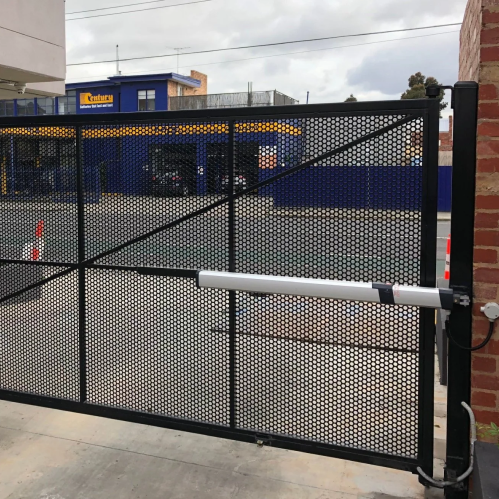
Still Cutting Concrete to Detect Vehicles? There's a Smarter Way
For decades, detecting a vehicle at an automatic gate meant one thing: saw-cutting grooves into your driveway, embedding wire loops, and sealing it all back up. It worked, but it was disruptive, expensive, and hard on your driveway surface.
Newer sensor technologies have changed this entirely. Modern vehicle exit sensors now fall into four main categories: wired exit sensors, wireless bolt-down (E Loop), virtual loop (OPTEX), and Laser radar (BEA LZR-I30). Each offers a genuine alternative to the concrete saw. This guide breaks down the strengths and limitations of each type so homeowners, property managers, and installers can pick the right sensor for their specific situation.
The Problem With Traditional Ground Loops
An inductive ground loop works by embedding a wire coil into a groove cut into asphalt or concrete. When a vehicle's metal mass passes over the coil, it changes the loop's inductance, and the detector signals the gate controller to open. It's proven technology, and a properly installed loop can last a decade or more.
But the installation process is far from simple. A contractor needs to saw-cut the pavement, lay the wire, and reseal the surface. This can disrupt traffic for hours or even days, and the process is labour-intensive from start to finish.
Australian conditions are particularly tough on buried loops. Pavement cracking from heat expansion, varied soil types causing slab movement, and water intrusion from heavy rains all shorten loop lifespan significantly. Once a loop fails, the problems compound.
A failed loop left in place is a well-known headache. The abandoned coil can act as a shorted turn, producing false detections and detector lock-up that are notoriously difficult to trace. Many technicians have spent hours chasing phantom triggers caused by old wire sitting in the ground.
Then there's the cost reality. A two-loop configuration (one for detection, one for safety) typically runs AUD $400 to $1,200 per lane for cutting, sealing, and wiring alone. When a loop fails, a repair callback involving a return visit, concrete cutting, loop replacement, and resealing costs AUD $800 to $2,500 each time. Over a few years, those callbacks can far exceed the cost of a modern above-ground alternative.
For homeowners with exposed aggregate, stamped concrete, cobblestone, or paver driveways, the saw-cut approach is especially risky. These decorative surfaces are easily damaged, and repair is often impossible to match perfectly.
It's also worth noting that slide and swing gates often require more than three ground loops for activation and vehicle protection. That complexity pushes traditional installations into territory where the cost and disruption are hard to justify.
Modern Vehicle Exit Sensor Types Explained
Modern vehicle exit sensors fall into four distinct categories, and all share one critical advantage: they mount above ground or bolt to the surface. No trenching, no concrete cutting, no driveway damage. These sensors can also be repositioned or reused if site conditions change, something a buried loop simply cannot offer.
Before comparing individual products, one key distinction matters. A presence sensor holds the gate open while a vehicle remains in the detection zone. A motion/activation sensor triggers only on movement. For gate safety, presence detection is generally preferred, because a motion-only sensor may allow the gate to close on a stationary vehicle in the zone.
Wired Exit Sensor: The Entry-Level Option
The Cartell wired exit sensor is the simplest modern alternative. It mounts on a post or gate housing and connects directly to the gate controller via a cable run. No driveway cutting required. You can run the cable through conduit along the side of the driveway in most scenarios.
This type suits new installations where wiring is already being run to the gate motor. If the cable path is straightforward and a power source is nearby, it's the most cost-effective option available.
For residential or acreage driveways with a simple layout, a wired exit sensor does the job reliably. At AUD $440, it's a sensible starting point for homeowners upgrading from, or looking to avoid, a ground loop. The main limitation is the cable run itself; in retrofit situations where running new wire is difficult or impractical, a wireless option may be a better fit.
E-Loop Wireless Bolt-Down Sensors: No Trenching, No Hassle
The E Loop concept is straightforward: sensors bolt directly to the concrete driveway surface using a drill and bolts. No trenching, no saw-cutting, no resealing. Installation takes a fraction of the time a ground loop requires.
Two variants cover most residential and commercial needs. The E Loop Mini Residential is priced at AUD $440 and designed for home driveways. The E Loop Wireless, at AUD $770, is built for industrial and warehouse applications where heavier traffic and tougher conditions demand a more robust unit.
The specs matter here. Both feature 128-bit high-security encryption, a wireless range of up to 50 metres, and a 10,600 mAh battery rated for up to 10 years of operational life. For larger properties or sites where running cable is impractical, that wireless range and battery longevity are genuine advantages.
One practical benefit that's easy to overlook: the E Loop's defined detection zone reduces false activations. Buried probe sensors detect vehicles within roughly a 4-metre radius and can pick up cars from neighbouring driveways. For suburban Australian properties where driveways sit close together, that's a real-world problem the E Loop avoids.
These sensors suit residential driveways, small commercial sites, leased properties, and any situation where driveway cutting is off the table. You can browse the full Vehicle Detection Sensors for Automatic Gates range, which includes the E Loop Mini, E Loop Wireless, and other bolt-down options.
OPTEX Virtual Loop: Smart Detection for Demanding Sites
The virtual loop takes a different approach. The OPTEX OVS-02GT mounts above ground on a wall, pole, or barrier housing with no surface contact with the driveway, making it ideal for decorative surfaces and drainage-sensitive areas.
Key specifications: the sensor detects vehicles up to 8 metres away with a 90° to 95° wide-angle adjustment. It carries an IP66 weatherproof rating and operates across a temperature range of -30°C to 50°C, covering Australian climate extremes comfortably.
What sets the OVS-02GT apart is its intelligence. Unlike a ground loop that only senses metal mass, this sensor can distinguish vehicles from pedestrians and bicycles, preventing accidental gate openings. It detects both stationary and moving vehicles at speeds up to 35 km/h, making it a true presence sensor that holds the gate open while a vehicle is in the zone.
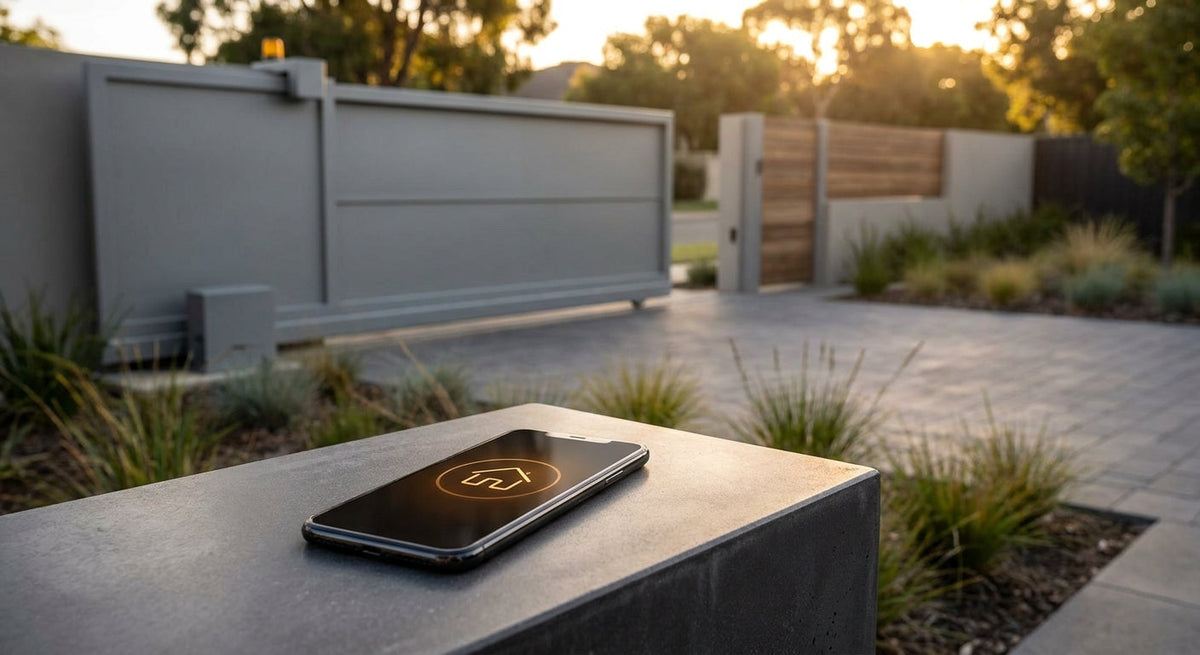
Real-time configuration and monitoring via a mobile app positions this sensor within the broader smart home and smart property ecosystem. For property managers overseeing multiple access points, that remote visibility is a significant operational benefit.
The OPTEX OVS-02GT is compatible with major gate automation systems including BFT, FAAC, Centsys, Beninca, Roger and Sommer gate motors, typically without additional wiring or control board changes. It's best suited for commercial properties, boom gates, parking facilities, drainage-sensitive areas, and premium residential sites with decorative driveways.
Bircher Easy Loop Sensor - Adjustable bracket & slim design
The EasyLoop is your hassle free vehicle detection solution. No digging, no concrete cutting — just mount it above ground and you're done. It uses smart radar to spot vehicles coming and going while ignoring pedestrians. Rain, fog, snow or dust? No problem. It handles it all with IP66 weatherproof toughness. Mount it 0.8m high at whatever angle works for you, 90° or 45°. Control everything from your phone app. The sensor learns your site and only alerts you to actual vehicles, cutting out false alarms. Perfect for parking lots, toll stations and business parks. Keeps everyone safe including vehicles and people, without expensive construction work. Priced at $696 its a great quality sensor at
BEA LZR-I30 Laser Radar: Precision for High-Security Sites
The BEA LZR-I30 sits at the premium end of the spectrum. It uses four laser-based curtains to create a 3D safety zone, monitoring both people and vehicles in indoor and outdoor settings with exceptional precision.
This is the specialist tool for environments where safety compliance and detection accuracy are non-negotiable: industrial facilities, government sites, schools, prisons, and high-traffic commercial entrances. For most residential and standard commercial applications, it's more capability than required. But when safety margins cannot be compromised, the LZR-I30 is the right choice.
Which Vehicle Exit Sensor Is Right for You? A Quick Decision Guide
- Residential homeowner with a standard driveway: Cartell Wired Exit Sensor (AUD $440) or E Loop Mini (AUD $495)
- Homeowner with a decorative or premium driveway (exposed aggregate, stamped concrete, pavers): E Loop Mini or OPTEX OVS-02GT or Bircher Easy Loop
- Commercial property manager or installer retrofitting an existing site: E Loop Wireless (AUD $648) or OPTEX OVS-02GT or Bircher Easy Loop
- Industrial facility, boom gate, or high-security site: Bircher Easy-Loop OPTEX OVS-02GT or BEA LZR-I30
- Leased or temporary site where sensors must be removed and reused: E Loop Wireless or OPTEX OVS-02GT
The total cost of ownership argument is clear. A quality above-ground sensor at AUD $440 to $1,000 upfront compares very favourably to ground loop call backs costing AUD $800 to $2,500 each. One or two call backs and the ground loop has already cost more than the modern alternative would have from day one.
All sensors listed are compatible with BFT, FAAC, Centsys, Beninca, Sommer, and Nice gate systems. In most cases, no additional wiring or control board changes are required.
Get Expert Advice Before You Buy
Powered Gates Australia has been operating since 2015, with over 4,000 customers and more than 2,500 installations completed. As an authorised distributor of BFT, FAAC, Beninca, Centsys, Nice, and Sommer, every sensor we stock is backed by manufacturer support and our own 2-year back-to-base product warranty. We also carry AUD $10 million in public liability insurance, and our team is police-checked and working-with-children checked for all site types.
If you're unsure which sensor suits your specific driveway layout or gate system, our team offers free expert advice via chat, phone, or photo upload. Send us a photo of your driveway and gate setup and we'll recommend the right option.
We deliver Australia-wide with free shipping on qualifying orders. For those in Melbourne who prefer a fully managed solution, our professional installation and servicing team handles everything from site assessment to commissioning.
The Bottom Line: Smarter Sensors, Simpler Installs
Modern vehicle exit sensors, wired, wireless bolt-down, virtual loop, or laser radar, offer a more cost-effective path than traditional ground loops for most Australian residential and commercial applications. The right choice depends on your driveway type, site conditions, budget, and the level of detection intelligence you need.
The technology has matured, the price points are accessible, and expert support is available to get it right the first time. With the global gate automation market valued at over AUD $15 billion and growing at 8.5% annually, the industry is moving fast. Getting your sensor choice right from the start protects your driveway, your gate system, and your long-term budget.

Leave a comment
All comments are moderated before being published.
This site is protected by hCaptcha and the hCaptcha Privacy Policy and Terms of Service apply.