
Why Slopes Change Everything About Sliding Gates
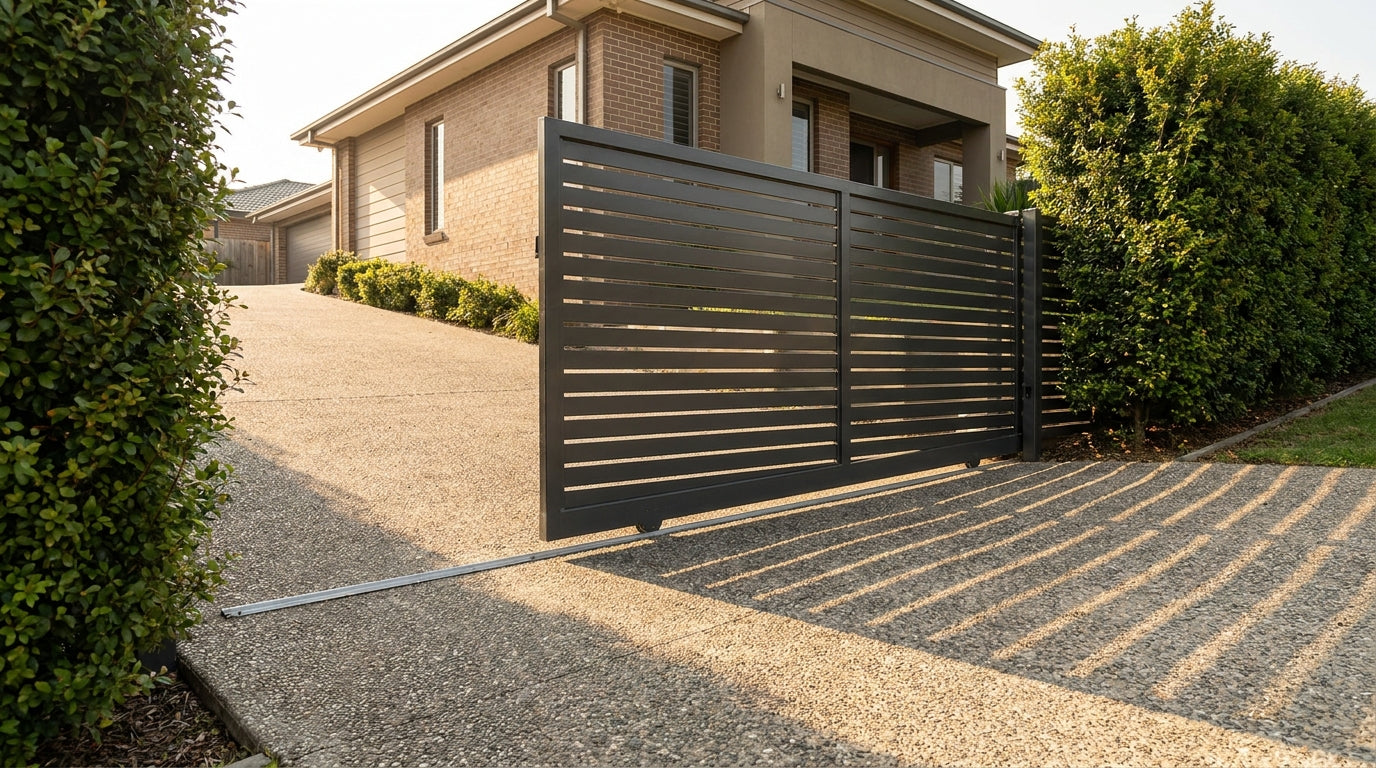
Your gate is on a slope, and that changes everything about your motor choice. Sliding gates are the right option for sloped driveways because they move parallel to the fence line. Unlike swing gates, which arc into rising or falling ground and jam against the surface, a sliding gate avoids that collision entirely.
A slope introduces three core challenges that flat level ground installations never face including increased motor load (the motor must push the gate uphill against gravity), dramatically more run back space, and a genuine safety hazard during power failures or manual release. By the end of this article, you'll know exactly what motor, damper, and layout your sloped site needs.
The Run-Back Space Rule: Why You Need 4–5x the Gate Width
On flat ground, a standard tracked sliding gate needs roughly 1.0 to 1.2 times the opening width as run-back space. So a 4-metre gate needs about 4 to 5 metres of clear space beside the opening for the gate to slide into. Simple enough.
On a sloped block, that number jumps to 4 to 5 times the gate width. This rule comes from years of real world sloped site installations across Australia, and it accounts for gravity pulling on the gate, the angle of the track, the motor's positioning requirements, and the safe stopping distance needed to prevent runaway. A 4 metre gate on a slope can require 16 to 20 metres of usable run-back space, a figure that surprises most homeowners..
When side space is genuinely limited, telescopic (stacker) gates solve the problem. A two-panel telescopic gate over a 6-metre opening retracts into just 3.4 metres. A 3-metre opening retracts into only 1.7 metres. However, telescopic gates multiply the motor load: a two-panel telescopic gate carries an effective motor load of 1.5 times that of a single-panel gate of the same weight, and a three-panel gate is 2.33 times. Slope multiplies this further, requiring a significantly larger motor than you might expect.
Not sure if your block has enough room? Upload a photo of your driveway through our website or use our live chat for a free, site-specific space assessment. We'll measure what you're working with and recommend the right configuration.
Motor Selection: The Slope Penalty You Must Account For
Here's the number that stops most people mid-conversation: the Beninca Bull 1200kg Turbo is rated for gates up to 1,200 kg on flat ground, but approx 200 kg on a slope. That's an 83% drop in capacity from a single variable: the angle of your driveway. This is what we call the motor capacity cliff, and it catches out DIY buyers and inexperienced installers constantly.
A standard residential motor rated for level ground will struggle or fail outright on an incline. The motor must actively push the gate uphill against gravity on every opening cycle, and it must resist the gate's tendency to accelerate downhill on every closing cycle. A 200 kg gate on a slope can behave like a much heavier gate, forcing the motor to work harder and significantly shortening its lifespan.
For residential sliding gates on slopes, we recommend four motors suited to the task:
- Beninca Bull 1200kg Turbo – 24VDC motor, virtual encoder, anti-crushing safety, 25.5 m/min operating speed, optional battery backup
- Tousek Pull 240V – a robust 240V motor built for sustained high-torque operation
- Roger Medio 600kg – reliable mid-range option with strong uphill performance
- Centsys D10 – a proven industrial-grade motor suited to heavier residential gates on inclines
All four are available from Powered Gates Australia. For telescopic gates on a slope, the compounding load effect (1.5x or 2.33x) means motor sizing must be calculated carefully. Generic "get a bigger motor" advice is not enough. Contact us with your gate weight, slope angle, and gate type for a specific recommendation.
The Radial Damper: Your Gate's Parachute Brake

A radial damper (also called a hydraulic gate damper) is a mechanical device that resists the gate's descent downhill while freewheeling when the gate ascends. Think of it as a parachute brake: it only activates when the gate is moving in the dangerous direction.
Here's the hazard most people don't consider. When the power cuts out, or when someone pulls the manual release lever on a sloped gate, the gate is free to roll. On an incline, it accelerates downhill at an uncontrollable speed. This is a serious and underreported danger. Safe Work Australia has recorded multiple fatalities from gate entrapment, and a runaway gate on a slope generates enormous force.
The radial damper prevents this scenario entirely, even without electric power. It's a passive safety device that works mechanically. It also protects the motor by considerably reducing the forces acting on the drive shaft during the closing (downhill) cycle, extending gearbox life.
A radial damper is not optional on a sloped installation. It is a safety-critical component.
Damper selection depends on your gate weight and slope angle. The formula is:
M [Nm] = P × sin(ß) × 0.032
A worked example for a 400 kg gate:
- A 7 Nm damper handles a 400 kg gate on a slope of up to 4% incline (140mm slope)
Getting the damper size wrong leaves you under protected. If you're unsure of your slope angle, send us a photo and we'll help you calculate the correct damper rating.
Installation Details: Track, Motor Pad, and Gate Fabrication
One detail that trips up many installers: the gate track must follow the same incline as the driveway. Do not pour the track footing level on a sloped site. The track runs with the slope.
The motor mounting pad, however, must always be poured level and elevated enough so rainwater runs around it, not through the motor housing. The rack must align precisely with the motor's gear for correct operation, and that alignment depends on a level pad regardless of the surrounding ground angle.
For a clean visual result and correct clearance, consider a raked gate: a custom-fabricated gate panel with an angled bottom rail that matches the driveway slope. This is specialist fabrication work, but it ensures the gate looks intentional rather than cobbled together.
On very steep grades, ground wheels can dig into the side of the track, increasing friction. Address this at the driveway-forming stage if possible. Where steep grades can't be avoided, cantilever sliding gates are often the better solution because they eliminate ground-wheel friction entirely.
Get Expert Advice for Your Sloped Site
A sloped sliding gate installation comes down to four key decisions: run-back space, motor selection, radial damper sizing, and correct track and pad installation. Get any one of these wrong and you're looking at a safety hazard, a compliance issue, or a motor that burns out in its first year.
Slope installations are not a DIY guessing game. The wrong motor or a missing damper creates genuine safety and legal risk.
As an authorised distributor of BFT, FAAC, Beninca, Centsys, Nice, and Sommer since 2015, with over 4,000 happy customers and 2,500+ completed installations across Melbourne, Geelong, and the Mornington Peninsula, we've seen every slope scenario there is. We offer free shipping on residential gate motor orders over $1,499 AUD and a 2-year warranty on all installations.
Upload a photo of your driveway, use our live chat, or call us for a free expert assessment. Our average response time is between 1 minute and 24 hours.
Not sure what your slope needs? Send us a photo and we'll tell you exactly what will work.

Leave a comment
All comments are moderated before being published.
This site is protected by hCaptcha and the hCaptcha Privacy Policy and Terms of Service apply.