
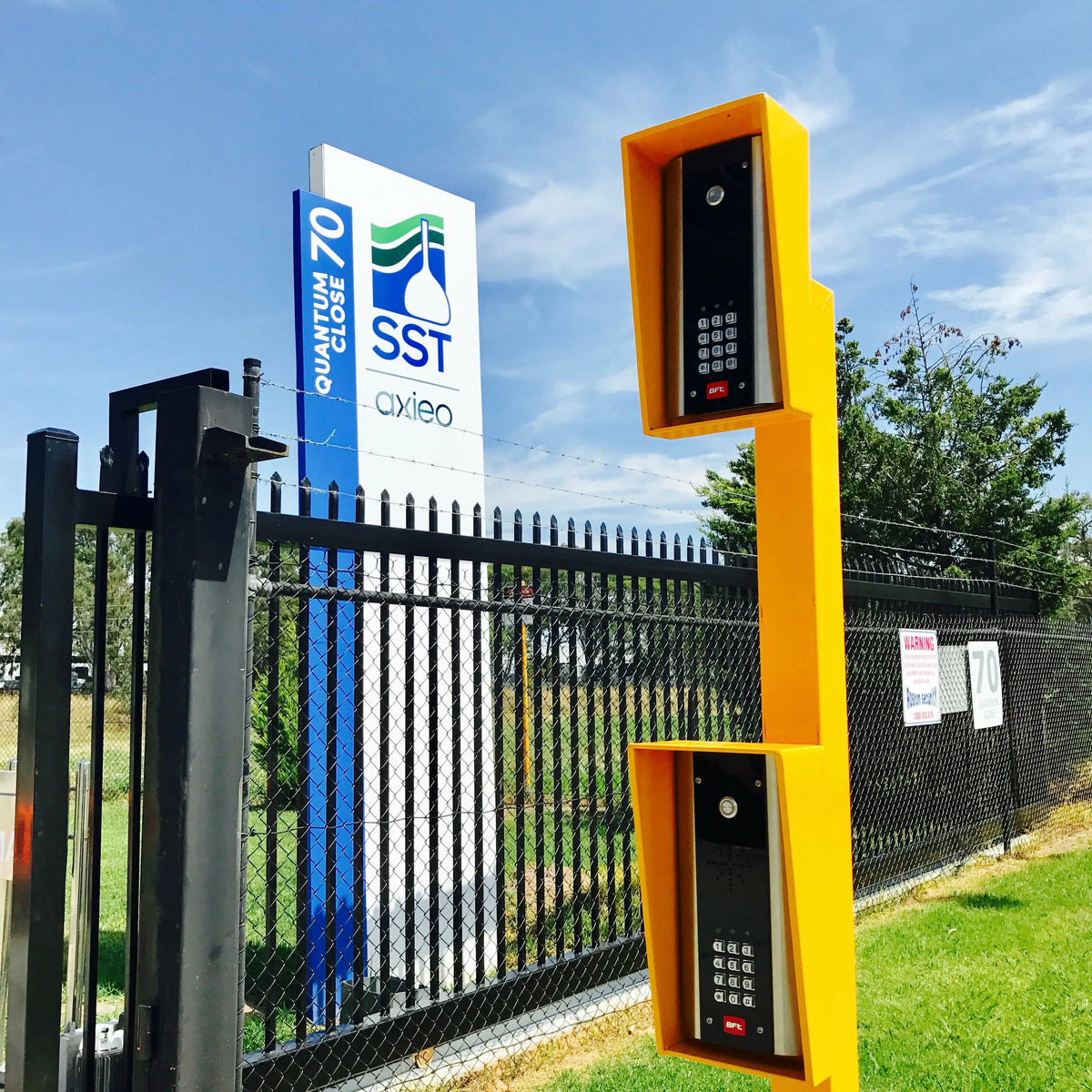
THE QUICK ANSWER BEFORE YOU READ ON:
Wired or Wi-Fi for suburban properties where the gate is close to the house. 4G for rural driveways, remote properties and any site where Wi-Fi doesn't reliably reach the gate. The decision comes down to three things: how far the gate is from the house, whether you have Wi-Fi signal at the gate, and whether a cable run is practical.
An automatic gate opens and closes on command. But if you can't see who's at the gate before you open it, you've only solved half the problem.
A gate intercom solves that problem; it lets you speak to visitors, see who's there on video, and open the gate without leaving your desk or your couch. The technology is straightforward. The part that catches buyers out is the connectivity, because wired, Wi-Fi, and 4G intercoms work completely differently, and installing the wrong type for your property is an expensive mistake.
Powered Gates Australia stocks both wired Panasonic video intercoms and AES 4G GSM systems. We also sell the gate motors they connect to. This guide covers both so you can spec your complete system in one place.
For motor selection guidance, read our best sliding and swing gate motors guide for 2026. This article focuses on the intercom side of the equation.
How a Gate Intercom Connects to Your Gate Motor
Gate intercoms don’t open the gate on their own; they send a signal via a relay output (also called a dry contact) to the gate motor's trigger terminals. Those are the same two terminals your existing remote control uses to trigger the motor. When the intercom sends the open signal, the motor reads it the same way it reads a button press.
This means any intercom with a relay output wires into any gate motor with trigger terminals, which covers virtually every modern sliding and swing gate motor on the market. You don't need a specific intercom for a specific motor brand. The wiring is simple: two wires from the intercom's relay output to the motor's trigger terminals.
The connectivity type (wired, Wi-Fi, or 4G) is about how the intercom talks to your phone; the motor connection is the same regardless.
Wired Intercoms: The Reliable Choice for Short Cable Runs
How it works:
A wired intercom runs a low-voltage cable from the gate station (the unit at the gate) back to the internal monitor inside the house. On a 2-wire system, that single cable pair carries both the audio/video signal and the gate open command. Once installed correctly, it works without Wi-Fi, without a SIM card, and without any ongoing subscription or connectivity dependency.
PGA product: Intercom, Video and Audio Kit, Panasonic, 7-inch Display with Door Station — $440
The Panasonic 7-inch kit includes a colour video door station and an indoor monitor with a 7-inch display. It shows you a live video feed of your visitor, lets you speak to them, and triggers the gate to open from the monitor.
When wired is the right call:
- Gate is within practical cable-run distance from the house (typically up to 80–100 metres for audio, shorter for reliable video quality)
- The driveway is paved and a conduit run is practical
- You want zero ongoing costs after installation
- Power is available at the gate location (most wired door stations need a small power supply at the gate)
When wired is not the right call:
- The gate is at the end of a long rural driveway where trenching 100+ metres of cable is impractical or prohibitively expensive
- There is no conduit path from the gate to the house
- The property is rented or leased and structural cable work isn't permitted
Wi-Fi Video Intercoms: App-Based Access Where Your Router Reaches
How it works:
A Wi-Fi intercom connects to your home router over your existing network. Visitor calls come through to your smartphone via an app rather than to a physical indoor monitor. You see video, speak to the visitor, and trigger the gate open from your phone — anywhere in the world with an internet connection.
The critical pre-purchase check:
This is where most Wi-Fi intercom installations go wrong: the Wi-Fi signal at the gate location.
A Wi-Fi intercom needs a reliable Wi-Fi connection at the gate. If your router is 40 metres away inside the house and the gate is mounted on a brick pillar, the signal strength there may be marginal or non-existent. Before ordering a Wi-Fi intercom, check the actual signal strength at the gate location using your phone. If it's weak or intermittent, the intercom will drop calls, miss triggers, and frustrate everyone who tries to use it.
A Wi-Fi extender or mesh node placed near the gate can solve this but add that to your budget and your planning. If the cable run for an extender is impractical, a 4G intercom is the simpler answer.
Video Doorbell vs Gate Intercom?
This question comes up often. A video doorbell (Ring, Nest Hello, etc.) cannot open a gate; it has no relay output. A gate intercom has a relay output specifically to trigger the gate motor. Do not buy a video doorbell expecting it to open your automatic gate because it won't.
4G/GSM Intercoms: The Standard Choice for Rural Gates and Long Driveways
How it works
A 4G GSM intercom has a nano SIM card inside. When someone presses the call button at the gate, the intercom calls your smartphone directly over the mobile network like a phone call. You answer, speak to the visitor, and open the gate from the app or by pressing a key tone on the call. No Wi-Fi required. No cable run from gate to house required.
PGA products:
- AES 4G GSM Audio Intercom with PIN Code Keypad — $1,795 (normally $1,980)
- AES 4G GSM Audio Multicom Classic for Apartments — $2,970
The AES range is purpose-built for Australian residential and commercial gate applications. The standard unit suits apartment blocks, strata complexes, and multi-tenancy sites where multiple residents each need individual access; each resident gets their own virtual button on the intercom panel.
The SIM card: What it costs and what you need
A 4G intercom requires an active SIM; this is the one ongoing cost Wi-Fi and wired intercoms don't have. A basic prepaid data SIM from Telstra, Optus, or Boost Mobile covers it; you don't need a full voice plan, just a SIM that stays active. Budget approximately $10–20 per month depending on the plan and carrier.
For most rural properties, this cost is negligible compared to the alternative: a cable trench from the gate to the house that might run 3,000 to 8,000 in labour alone, depending on the driveway length and surface.
When 4G is the right call:
- Rural or acreage property where the gate is more than 50 metres from the house
- No reliable Wi-Fi signal at the gate location
- Solar or off-grid gate (4G intercoms draw very low standby power; more on this below)
- Construction site or temporary access point (no Wi-Fi infrastructure on site)
- Any site where running cable is impractical, expensive, or not permitted
Coverage check:
4G intercoms require mobile coverage at the gate location. In most of metropolitan and regional Australia, Telstra and Optus coverage is strong. For very remote properties, check coverage maps for the gate's specific location before ordering. If coverage is marginal at the gate, a Telstra SIM (the widest rural network in Australia) is the safest choice.
Intercoms for Solar and Off-Grid Gates
If your gate is solar-powered, the intercom you add to it needs to be compatible with that power budget.
4G GSM intercoms are the standard recommendation for solar gates. In standby mode, they draw minimal power; the intercom only actively draws significant current when a call is being made. Between calls, it sits idle, consuming very little from the battery.
Wi-Fi intercoms maintain a constant connection to the router, which means a constant (if small) power draw 24 hours a day. On a solar system already sized for the gate motor, adding a continuously connected Wi-Fi device can create a power deficit over consecutive overcast days.
Wired intercoms require a mains power supply at the gate for the door station; not suitable for an off-grid installation without additional power provision.
For more detail on solar gate setups, read our solar boom gate guide.
Not sure which system suits your site? Get in touch with your gate setup details and we'll confirm the right intercom and motor combination before you order.
Which Intercom Suits Your Property? Read the Straight-Up Guide
Scenario 1: Short suburban driveway, gate within 30–50m of the house, mains power at gate
Use: Panasonic 7-inch wired video intercom ($440)
The most cost-effective option for a standard home installation. Install once, no ongoing costs, reliable 7-inch colour video. If the driveway is sealed and a conduit run is practical, this is the cleanest solution.
Scenario 2: Suburban driveway, gate 30–80m from the house, strong Wi-Fi signal at gate
Use: Wi-Fi video intercom
If you've confirmed the Wi-Fi signal is reliable at the gate location, a Wi-Fi system gives you video and app-based access without a cable run. Confirm signal strength before ordering.
Scenario 3: Rural or acreage property, gate more than 50m from the house, no Wi-Fi at gate
Use: AES 4G GSM Audio Intercom with Keypad ($1,795)
The 4G intercom is the correct specification for this scenario. No cable run, no Wi-Fi infrastructure needed. The SIM cost is the only ongoing expense, and it's a fraction of what a cable trench would cost.
Scenario 4: Solar or off-grid gate
Use: AES 4G GSM Audio Intercom ($1,795)
Low standby power draw, no network dependency, compatible with solar-powered gate systems. Confirm the solar system's battery capacity accommodates the additional load before ordering.
Scenario 5: Apartment block, strata complex, or multi-tenancy property
Use: AES 4G GSM Multicom Classic ($2,970)
Each resident gets their own virtual button. Managed centrally, works over 4G, no building-wide Wi-Fi infrastructure required. Suitable for body corporate and strata access management.
What Does a Gate Intercom Cost in Australia? PGA's Range
Installation cost note:
Product price is only part of the budget. Wired systems require a cable run, a conduit, cable, and labour. For a 40m driveway on a sealed surface, a licensed electrician or cabler might quote 500–1,500 depending on access and conduit requirements. 4G systems require only the relay wiring to the gate motor (a simple two-wire connection), which is typically part of a standard gate installation.
Browse the full intercom range: PGA intercom collection
A Note on Smart Gate Controllers vs Intercoms
A smart gate controller (like the Remootio 3 or Palgate Spider 50) adds app-based control and monitoring to an existing gate motor. It lets you open the gate from your phone, check gate status, and manage access. It does not provide visitor communication; there's no call button, no two-way audio, no video.
A gate intercom adds visitor communication. Someone arrives at the gate, presses a button, and calls your phone. You see them (on video models), speak to them, and decide whether to open the gate.
Some properties use both: an intercom for visitor communication and a smart controller for convenience access (residents opening the gate with their phone without pressing a call button).
For more on smart controllers, read our phone-controlled gate guide.
Ready to sort your gate intercom? Browse the full range, wired Panasonic video kits from $440, AES 4G GSM systems from $1,795, or call 1300 71 71 39 and we'll match the right intercom to your gate motor and property in one call.
Frequently Asked Questions
Can I add an intercom to my existing automatic gate?
Yes. Gate intercoms connect to your existing motor's trigger terminals; the same two terminals your remote control uses. As long as your motor has a trigger input (virtually all modern sliding and swing gate motors do), any intercom with a relay output will work with it. You do not need to replace or upgrade your gate motor to add an intercom.
Does a Wi-Fi gate intercom need to be near the router?
Yes, the intercom needs a reliable Wi-Fi signal at the gate location, not just at the house. Check the actual signal strength at your gate before ordering. If signal is weak or intermittent there, a Wi-Fi extender or mesh node can help, but adds cost. If extending Wi-Fi to the gate is impractical, a 4G intercom is the simpler solution.
Do I need a SIM card for a 4G gate intercom?
Yes. A 4G GSM intercom contains a nano SIM card slot and requires an active SIM to connect to the mobile network. A basic prepaid data SIM from Telstra, Optus, or Boost Mobile works. Budget approximately $10–20 per month to keep the SIM active. This is the only ongoing cost a 4G intercom has.
What is the difference between a video doorbell and a gate intercom?
A video doorbell (Ring, Nest Hello, etc.) has no relay output. It cannot open an automatic gate. A gate intercom has a built-in relay output specifically designed to trigger a gate motor's trigger terminals. If you want to open an automatic gate remotely, you need a gate intercom, not a video doorbell.
Can a gate intercom work with any gate motor brand?
Yes. The intercom connects to the gate motor via the motor's trigger terminals using a simple two-wire relay connection. This is a standard input found on virtually all modern gate motors: Centsys, BFT, Beninca, FAAC, BFT, Nice, Hi Motion. The intercom brand and the motor brand do not need to match.
Which intercom suits a solar-powered gate?
A 4G GSM intercom is the standard recommendation for solar gates. In standby mode, 4G intercoms draw very low power. Wi-Fi intercoms maintain a constant network connection and draw more power continuously. Wired intercoms typically require mains power at the gate door station, which is not available on an off-grid installation. For 4G intercoms on solar gates, confirm your battery bank can handle the additional load before ordering.

Leave a comment
All comments are moderated before being published.
This site is protected by hCaptcha and the hCaptcha Privacy Policy and Terms of Service apply.