
THE QUICK ANSWER BEFORE YOU READ ON
Use a ground track gate if your driveway is flat and sealed and cost is a primary consideration and use a cantilever gate for everything else, such as gravel, slopes, heavy vehicles, high-cycle industrial sites, and anywhere a track at ground level would cause ongoing problems.
Powered Gates Australia supplies both systems. Italian-made cantilever hardware for residential and industrial applications, and ground track kits for standard driveways. We're not going to push you toward the more expensive option if it's not the right one for your site. This guide cuts straight to the decision. If you already know you need a cantilever system, browse the full cantilever kit range — residential to industrial, shipped Australia-wide.
If you're still deciding, read on.
What's the Difference and How Does Each System Work?
Both are sliding gates. The difference is how they're supported.
Ground Tracks
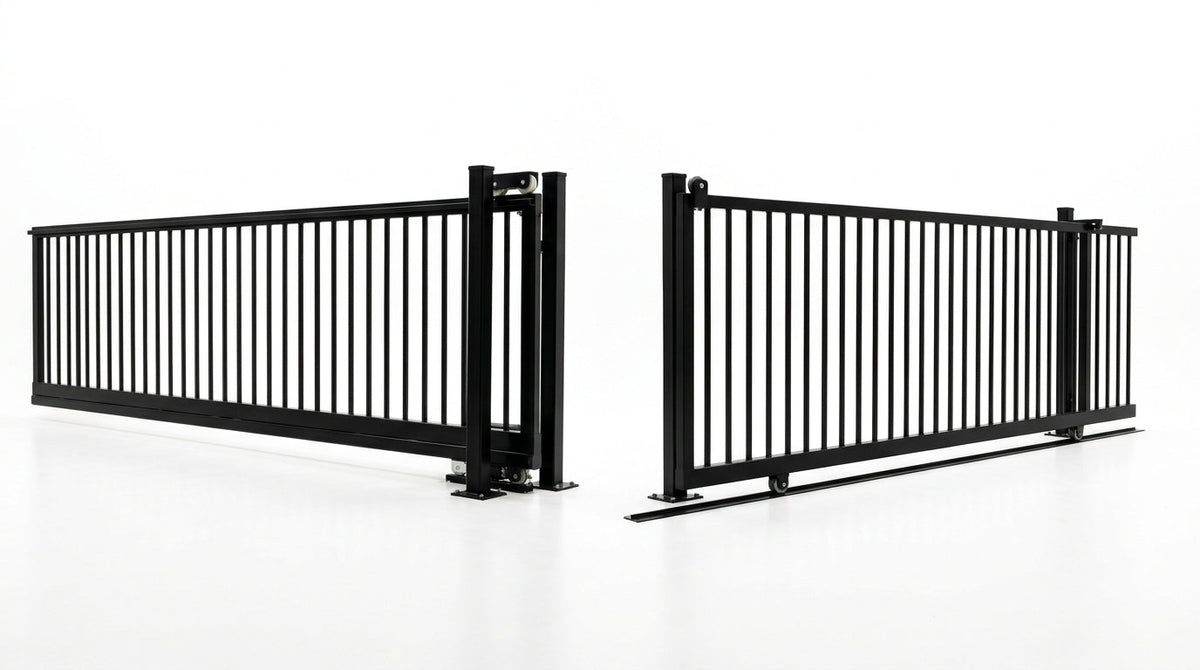
A steel rail is bolted across the driveway at ground level. The gate sits on wheels that run inside the channel, and the gate slides open and closed along that track. It's the most common residential sliding gate system and the one most people picture when they think "sliding gate." Simple, cost-effective, proven.
The limitation is the track itself. Anything at ground level collects debris, gets damaged by vehicles, and requires a perfectly level surface to work properly. On a clean suburban driveway with sealed pavement, that's manageable but on a gravel driveway or a rural property, you're fighting the environment every time it rains.
Cantilever
There's no track on the ground. Instead, the gate slides along the fence line on carriages mounted to posts, floating entirely above the surface. The gate is longer than the opening and the section that extends behind the post when the gate opens (called the tail) is what keeps the gate balanced.
Think of it like a seesaw: the tail balances the opening section.
The structural advantage is that the gate never contacts the ground during operation and there's nothing at ground level to fill with dirt, nothing to damage, nothing to level.
Both systems use the same sliding gate motors: a gear rack is fixed to the base of the gate, and the motor drives it open and closed. The motor doesn't know whether it's running a cantilever or a track-mounted gate. The hardware system is the decision, not the motor.
When Cantilever Is the Right Call: 5 Site Conditions That Decide It
Scenario 1: Gravel or unsealed driveway
Use: Cantilever
Debris fills a ground track fast. After rain, gravel and mud wash into the channel. Leaves, dirt and stones accumulate around the wheels. On an unsealed driveway, it's a weekly maintenance task. A cantilever gate has nothing at ground level to obstruct. The surface below the gate doesn't affect how the gate operates.
Scenario 2: Sloped or undulating surface
Use: Cantilever
A ground track needs a level surface. If your driveway has any meaningful slope or change in grade across the gate opening, you're either doing significant groundwork to create a level run, or you're accepting a track that won't drain properly and will shift over time.
Cantilever gates span any grade. The gate floats above the surface and what's underneath doesn't matter.
For more detail on handling sloped driveways specifically, read our sliding gates on slopes guide.
Scenario 3: Heavy vehicle access
Use: Cantilever
Ground tracks get damaged by heavy loads. A concrete truck, a loaded semi, a tractor, any vehicle that crosses the track at an angle puts lateral load on the rail.
Over time, the track shifts, the wheels lose alignment, and the gate starts dragging. On a property with regular heavy-vehicle access, a ground track becomes a maintenance problem that compounds. Cantilever gates are unaffected by vehicle traffic because nothing at ground level can be damaged.
Scenario 4: High-security or industrial sites
Use: Cantilever
Cantilever gates are harder to derail than ground track gates. There's no track to pop out, no channel to clear. For warehouses, schools, industrial access points, and any site where gate reliability is non-negotiable, cantilever hardware rated for the load eliminates the most common failure points.
Scenario 5: High-cycle applications
Use: Cantilever
A site opening and closing the gate 50 to 100 or more times per day puts sustained load on every component. On a ground track, that load concentrates on the track channel and the wheels running through it.
Track wear, wheel wear, and debris accumulation compound over time. Cantilever carriages carry the load through the monorail, not a ground-level track, and there's no debris accumulation issue. Over a five-year period, the maintenance cost difference on a high-cycle site is real.
Sound like your site? Get in touch with your gate width and surface type; we'll confirm the right kit tier and motor before you order.
When Ground Track Is the Right Call
Flat, sealed driveway with no debris risk
On a clean concrete or asphalt driveway that's level and well-drained, the operational limitations of a ground track don't apply. The debris concern doesn't exist, the level surface is already there, and you're not fighting the environment. Ground track is simpler to install and lower in cost. It's the right choice.
Cost-sensitive residential installs
Ground track kits start from around $990. Cantilever kits start from $1,455 for the residential small (4m) and go to $6,820 for the industrial XL. The cost difference is real: on a flat, paved driveway, the higher upfront cost of cantilever doesn't buy you enough practical advantage to justify the premium. Ground track is the honest recommendation.
Limited run-back space behind the post
This is the most important pre-purchase check for cantilever, and the most commonly missed. A cantilever gate needs a tail extending behind the post when it opens. That tail needs clearance; no parked cars, no garage wall, no fence within the travel path.
The rule of thumb: You need approximately 1.5 to 2 times the opening width as run-back behind the post. For a 4m opening, that's 6 to 8 metres of clear fence line behind the post. The XL industrial kit specifies a minimum 4m tail with a 15m monorail for gates up to 10m wide.
If that space doesn't exist, cantilever isn't viable regardless of every other site condition. Ground track is the answer. Measure the run-back space before you order anything.
Cost: What Each System Costs in Australia
Cantilever Kits
Ground Track Kits
Ground track sliding gate kits start from approximately $990 for residential applications. Browse the kits and bundles collection for current pricing across the full range.
The real cost comparison over time
The upfront cost difference is genuine. But the calculation changes on a site where ground track is the wrong system.
A track that fills with debris every wet season, a rail that shifts under heavy vehicles, a wheel set that wears out from sustained high-cycle use; each repair and replacement adds to the total cost of ownership.
On the right site, cantilever pays for the premium. On a flat suburban driveway, it doesn't need to.
Choosing the Right Cantilever Kit: PGA's Range Explained
Once you've decided cantilever is right for your site, the next question is which tier. Here's how to read the range:
- Residential Small (up to 4m opening, $1,455): Suited to standard home driveways. 8-wheel carriages on a 6m monorail (total length including tail), minimum 1.5–2m tail. Cantilever residential kit — 4m.
- Medium (up to 6m opening, $2,380): For wider residential gates or light commercial entries. Same Hi Motion Italian hardware, stepped up for the additional span.
- Industrial Large (up to 8m opening, $2,320): Commercial and light industrial applications. Italian-made hardware rated for sustained use at schools, strata complexes, and commercial access points.
- Industrial XL (up to 14m wide / 800kg, $6,820): The heavy end. 9-wheel heavy duty carriages, 15m welded monorail, minimum 4m tail. For warehouses, transport depots, industrial estates, and any gate that pushes the limits of what residential hardware can handle. Cantilever industrial kit XL — up to 14m wide.
- Aluminium BOSS Kit (up to 8m monorail, $1,980): Aluminium extrusions with a stitch-weld monorail are lighter, rust-free, and faster to install than the steel-core kits. Suits residential and light commercial applications where weight and corrosion resistance matter. Particularly relevant for coastal properties where salt air accelerates rust on steel hardware.
All kits are supplied with Italian-made hardware from Hi Motion or BOSS. For motor selection guidance to pair with any of these kits, read our best sliding gate motors guide for 2026.
Installation: The One Thing Buyers Miss
The run-back space check
Measure from the post back along the fence line. The gate tail needs that space to be completely clear when the gate is fully open.
For the residential small kit: minimum 1.5–2m.
For the XL industrial kit: minimum 4m.
If you have a carport, a boundary fence, or a parked car in that zone, cantilever won't work and you need a different approach.
Complexity
Ground track installation is straightforward and within reach for experienced DIYers. Cantilever installation is more involved: the monorail alignment, the carriage positioning, and the gate balance all need to be set correctly for the gate to run smoothly.
For the industrial kits (large and XL), professional installation is recommended. For the residential kits, an experienced installer or a confident tradesperson with the installation guide is the right approach.
The motor is separate from the hardware
The cantilever kit provides the mechanical hardware: carriages, monorail, and the gear rack. The motor is purchased and installed separately. For a full explanation of what goes into a complete kit, see our sliding gate kit buying guide.
Automation: Both Systems Work With Any Sliding Gate Motor
Both cantilever and ground track gates are automated the same way: a gear rack is fixed to the bottom of the gate frame, and a sliding gate motor drives the rack to open and close the gate. The motor operates identically regardless of whether the gate is on a ground track or cantilever rollers. Any motor that suits your gate's weight and daily cycle count will work with either system.
Choose your hardware system first based on your site conditions. Then choose your motor based on gate weight, opening width, and daily cycle count. The two decisions are independent of each other.
Ready to go? Browse all cantilever kits, residential to industrial, or call 1300 71 71 39 and we'll confirm the right system and motor for your gate and site. Melbourne's summer renovation season is approaching. Now's the time to get this sorted.
Frequently Asked Questions
How much run-back space does a cantilever gate need?
As a rule of thumb, a cantilever gate needs approximately 1.5 to 2 times the opening width as clear run-back space behind the post. For a 4m opening, that's 6 to 8 metres of fence line behind the post where the gate tail travels. The PGA Industrial XL kit specifies a minimum 4m tail for gates up to 10m wide. Measure this space before ordering; if it isn't available, cantilever isn't viable and ground track is the correct answer.
Can a cantilever gate be installed on a sloped driveway?
Yes. This is one of cantilever's key advantages. A ground track requires a level surface; sloped driveways need significant groundwork to create a level run for the track. A cantilever gate floats above the ground entirely, so the surface grade below the gate is irrelevant. Cantilever is the standard recommendation for any driveway with meaningful slope or grade change across the gate opening.
Is a cantilever gate more secure than a ground track gate?
Generally yes, for two reasons. First, there's no gap between the bottom of the gate and the ground when closed, making it harder to crawl under (ground track gates have a small gap between the gate and the track channel). Second, cantilever gates are harder to derail; there's no track to pop out or shift, and the gate can't be lifted off a rail. For industrial security applications, cantilever is the preferred system for both these reasons.
How much maintenance does a cantilever gate need compared to a ground track gate?
On most sites, cantilever needs less. There's no track channel to clear of debris, no rail alignment to check after heavy rain or vehicle crossings, and no track surface to replace. Cantilever carriages need periodic lubrication and the monorail should be kept clean, but the underlying maintenance task list is shorter. On a gravel driveway or a high-cycle site, the difference in maintenance frequency is significant. On a clean suburban paved driveway, ground track maintenance is very manageable and the maintenance advantage of cantilever is minimal.
Can I retrofit a cantilever system to my existing gate frame?
Yes, in most cases. The cantilever hardware, carriages and monorail, attach to the gate frame via the monorail that is welded to the bottom of the gate. An existing gate frame can be retrofitted as long as it's structurally sound and the frame is compatible with the monorail width. The gate will also need to be extended to include the tail section if it was originally built for a ground track configuration. Confirm your gate's dimensions with us before ordering; contact our team with the gate width and frame type.

Leave a comment
All comments are moderated before being published.
This site is protected by hCaptcha and the hCaptcha Privacy Policy and Terms of Service apply.