
THE QUICK ANSWER BEFORE YOU READ ON:
A boom gate can run entirely on solar power with no mains connection. The system you need is straightforward: a 24V DC boom gate motor, a lithium solar battery kit, and a solar panel. Whether solar is right for your specific site depends on three things: how much sun your site gets, how often the barrier opens and closes, and whether there's a practical place to mount the panel.
A boom gate without mains power sounds like a compromise, but it isn’t. Done right, a solar-powered barrier runs just as reliably as a mains-connected unit and in some locations, it's the only practical option.
Getting mains power to a gate location isn't always straightforward. On a rural property, the cable run from the switchboard to the gate can be 50 metres or more. That's trenching, conduit, cable, a licensed electrician, and a bill that often exceeds the cost of the gate motor itself. For a caravan park entry, a construction site checkpoint, or a remote farm gate, solar is the right specification from the start.
For a broader look at boom gate types, duty cycles, and commercial applications, read our complete boom gate buying guide. This article focuses specifically on the solar question.
How a Solar Boom Gate Works: The 4 Components You Need
1. Solar panel
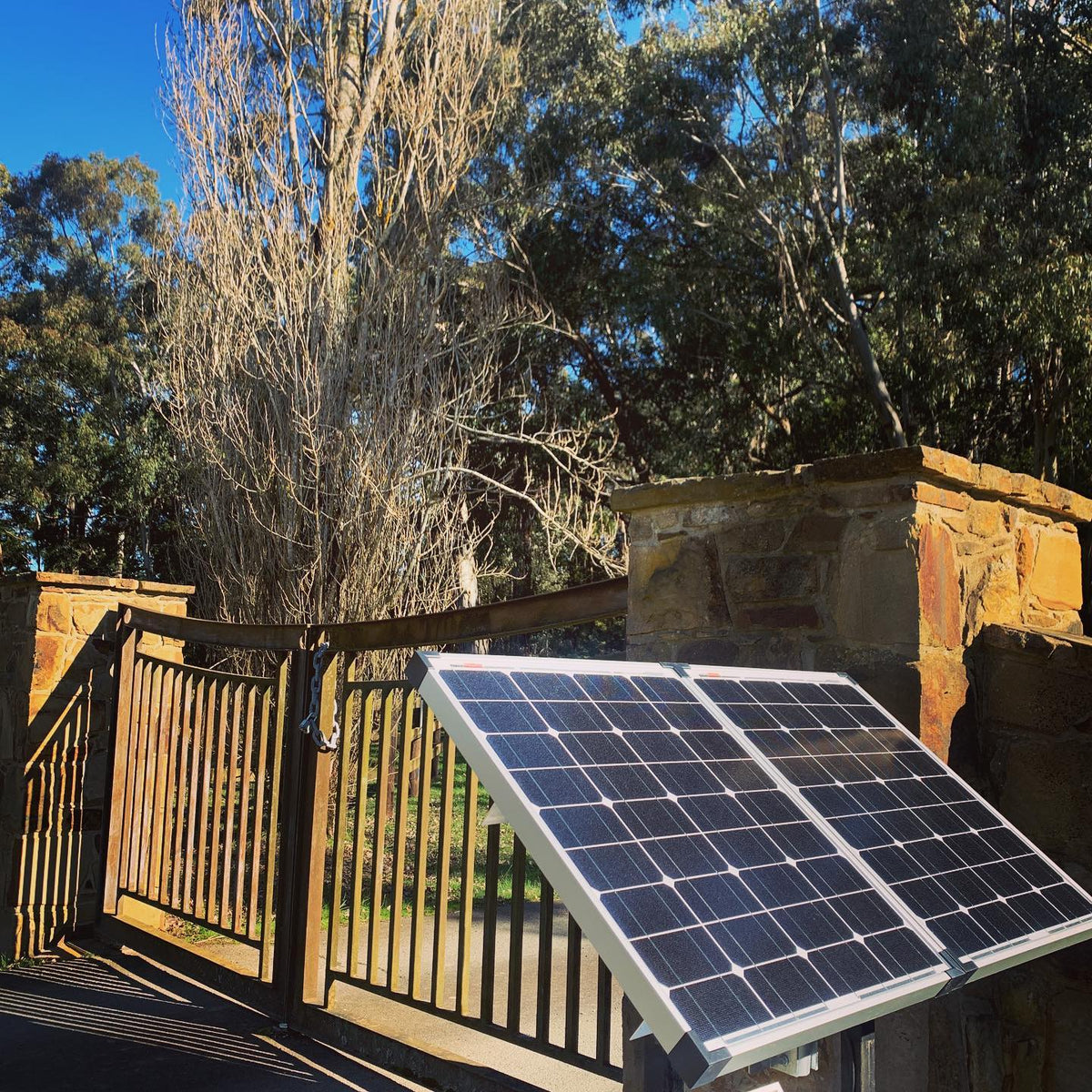
Collects sunlight and converts it to electrical current. For a boom gate running at moderate cycle rates (under 100 operations/day), a panel in the 100W–200W range is typically sufficient, depending on your location's solar hours and the panel's angle.
Australia's solar resource is strong; most of the country averages between 4.5 and 6.5 peak sun hours per day, which is more than enough to keep a well-specified system charged.
2. Lithium battery bank
Stores the energy the panel generates during daylight hours and powers the motor overnight and during overcast periods. A lithium battery (rather than older lead-acid technology) is the right choice for a boom gate application: lithium holds a charge more efficiently, tolerates deeper discharge cycles, performs better in heat, and lasts significantly longer.
The solar battery kit supplied with the Powered Gates Australia solar boom gate bundle is a 24V lithium system matched to the Beninca EVA motor's power requirements.
3. Charge controller
Sits between the panel and the battery. It regulates the charge current, prevents overcharging, and protects the battery from voltage spikes.
In Australian summer conditions, sustained 40°C-plus days in inland Victoria, Queensland, and Western Australia, a quality charge controller is what keeps the battery healthy over the long term. Do not skip this component or substitute a generic unit to save cost.
4. 24V DC boom gate motor
This is why solar works for boom gates: modern commercial-grade boom gate operators run on 24V DC, not 240V AC mains. A DC motor is naturally suited to battery-powered operation. The Beninca EVA, for example, is a 24V DC motor that draws from the same battery the solar panel charges.
At moderate cycle rates, the panel replenishes what the motor draws and at higher cycle rates, the battery depth of discharge needs to be managed, which is where the solar sizing conversation starts.
Where Solar is the Right Call: 5 Use Cases That Suit Off-Grid Barrier Operation
Stop thinking about solar as a workaround and start thinking about it as the correct specification for these situations.
Scenario 1 - Rural and farm entrances
Winner: Solar
The mains cable run to a rural gate is expensive. Trenching alone on a 50m+ run across an established driveway or paddock can cost more than the gate motor and solar kit combined but a solar boom gate eliminates that cost entirely.
Rural properties also tend to have minimal shade and strong solar access; the panel can be mounted on a post beside the gate with no obstructions. If the gate opens and closes fewer than a few hundred times a day, solar is the straightforward choice.
Scenario 2 - Caravan parks and camping grounds
Winner: Solar
Entry barriers at caravan parks and camping grounds typically operate at low-to-medium cycle rates; guests check in and out instead of hundreds of vehicles cycling through per hour. The solar profile suits this perfectly. The Beninca EVA's 3m to 8m adjustable arm also accommodates the range of vehicle types common at these sites, from family cars to caravans and campervans.
Scenario 3 - Construction sites (temporary access control)
Winner: Solar
Construction site access points move but mains connections don't. A solar boom gate on a temporary skid-mount can be relocated as the site develops, requires no electrician for the gate connection, and provides professional access control for contractors, deliveries, and visitors without a hardwired infrastructure commitment.
Scenario 4 - Remote industrial and agricultural sites
Winner: Solar
Mine site access roads, water treatment facility entrances, national park access points, and large agricultural properties all share the same characteristic: significant distance from mains infrastructure.
For these sites, solar is often the only viable power source. A battery bank sized for the specific cycle count and the location's solar profile provides continuous operation with no grid dependency.
Scenario 5 - Suburban properties where the mains cable run is cost-prohibitive
Winner: Solar
Not every solar situation is rural. In established suburban properties, the switchboard may be 30 or 40 metres from the gate entry point, and the cable run requires cutting through paving, garden beds, or established landscaping. When the electrical work costs more than the solar kit, the solar kit is the right answer.
Ready to go solar? The Solar Powered Beninca EVA boom gate includes the 24V lithium solar battery kit, a choice of 3m, 5m or 8m arm, and ships Australia-wide from $4,180.
When Solar Is NOT the Right Choice
Heavily shaded sites
Solar panels need direct sun for the majority of daylight hours to generate meaningful charge. If the gate entry point is permanently shaded by a building, a tree canopy, or a structure and there's no practical way to mount the panel in direct sun within a reasonable cable run, solar will underperform. A system running on partial charge is a system that will eventually stop opening the gate.
Very high-cycle commercial applications
The Beninca EVA motor is rated for up to 1,000 operations per day. At that cycle rate, the battery's energy draw is significant. A solar system that can reliably replenish 1,000 daily operations requires a carefully sized panel array and battery bank and the right specification depends on the site's solar hours, panel orientation, and seasonal variation in your region.
For a hospital car park, a large shopping centre, or any site consistently processing hundreds of vehicles per hour, get your installer to confirm the solar sizing is adequate before you order. Mains power may be the more practical solution at this cycle rate.
Sites with no viable panel mounting point
The panel needs to be within a practical cable run of the battery and motor. If the gate is recessed under a permanent overhead structure with no mounting surface in direct sun, mains power is the correct answer.
What Does a Solar Boom Gate Cost in Australia?
The Solar Powered Beninca EVA 3–8M Adjustable Boom Gate Barrier is available from $4,180, which includes the 24V lithium solar battery kit and the choice of arm length.
To put that in context: a standard mains-connected boom gate motor (not solar) starts from $2,980 for the Beninca EVA. Add the electrician's cost for a 240V connection at the gate location, including the cable run, trenching, conduit, and sign-off, and you're typically looking at $1,500 to $2,000 in electrical installation alone on an Australian commercial site.
The solar kit closes that cost gap and eliminates the ongoing grid dependency entirely. For sites where the mains cable run would exceed 30 metres, solar is very often the cheaper option over 5 years.
The Solar Boom Gate We Recommend: Beninca EVA Solar Bundle
The Solar Powered Beninca EVA is an Italian-made 24V DC electromechanical barrier rated for intensive use. Here's what the bundle includes and why each element matters.
Unlike a standard limit switch setup, an absolute encoder retains the boom arm's reference position even if the power is interrupted or the motor is manually released. When the gate powers back up from the solar system, after a cloudy period, or after a manual release, it knows exactly where the arm is and resumes normal operation without recalibration.
The LED strip across the arm is a practical safety feature for sites with dawn, dusk, or night-time access. It makes the boom arm visible to approaching drivers even in low light, relevant for caravan parks and rural properties where there's no ambient lighting at the entry point.\
The 24V lithium solar kit in the bundle is also compatible with BFT, FAAC, NICE, DEA and any other Italian-made 24V DC gate motor or boom gate, so if you're expanding a site with existing compatible motors, the same kit can power them.
Browse the full boom gate range →
Installation Notes: What's Required and Who Should Do It
- The solar kit connection: A 24V DC solar system does not require a licensed electrician for the gate motor connection in most Australian states, unlike a 240V mains connection, which requires a licensed electrician in all states. However, if the solar panel is mounted on a building structure, roof, or permanent installation, state-based solar and electrical regulations may apply. Confirm with your installer before proceeding.
- Mechanical installation: Boom gate installation, regardless of the power source, is a professional job. Correct positioning, concrete pad preparation, arm alignment, limit setting, and safety device installation all require an experienced gate technician. The motor and solar kit can be supplied, but the installation itself needs to be right.
- Panel placement: The panel needs unobstructed sun access for the majority of daylight hours. True north-facing at the appropriate tilt angle for your latitude is optimal. A rough guide for Australian sites: 30–35 degrees tilt is suitable for the south-east, 20–25 degrees for Queensland and the Northern Territory.
Not sure if your site suits solar? Get in touch with your site details and we'll advise on panel sizing and suitability before you order.
For Melbourne installations, our team provides full supply and fit, including concrete pad preparation, motor installation, solar kit setup, and access control configuration.
Ready to sort your solar boom gate?
Browse the Solar Powered Beninca EVA, available from $4,180 with the 24V lithium solar kit included, or call 1300 71 71 39 and we'll confirm the right arm length and setup for your site. Now is a good time to get a solar barrier in place before the summer construction season peaks.
Frequently Asked Questions
Can a solar boom gate run 24 hours a day?
Yes, with a correctly sized battery bank. The solar panel charges the battery during daylight hours, and the battery powers the motor overnight and during overcast periods. The lithium battery kit included in the Beninca EVA solar bundle is sized for normal commercial cycle rates. For very high-cycle sites (approaching 1,000 operations/day), confirm battery capacity with your installer to ensure overnight autonomy is sufficient for your usage pattern.
How many operations per day can a solar boom gate handle?
The Beninca EVA motor is rated for up to 1,000 operations per day. At moderate cycle rates (under 200–300 operations/day), the included lithium solar kit comfortably handles the energy demand. As daily operations increase toward the upper end of the motor's rating, the solar system sizing becomes more critical; battery depth of discharge and daily solar replenishment need to balance. Get this confirmed by your installer for high-cycle applications.
Does a solar boom gate work on cloudy days?
Yes, within limits. A lithium battery bank provides reserve capacity that carries the system through overcast periods. In most Australian locations, even a heavily overcast day still produces enough diffuse light to provide partial charge. The risk is extended overcast periods (multiple consecutive cloudy days) on sites with high cycle rates. In that scenario, the battery can deplete faster than it's being replenished. The system doesn't fail instantly, but it will eventually stop operating if the battery reaches its discharge limit.
What size solar panel do I need for a boom gate?
For a residential or light commercial boom gate running under 100 operations per day, a 100W panel is a common starting point. For a commercial site running 200–500 operations per day, 150W–200W is a more appropriate starting specification, depending on your location's average peak sun hours. The Beninca EVA solar bundle includes a matched kit for custom specifications outside this range, contact us with your cycle count and site location.
Can I add solar to my existing boom gate?
Yes, if your existing motor is a 24V DC unit. The 24V lithium solar kit stocked by Powered Gates Australia is compatible with BFT, FAAC, NICE, DEA, Beninca, and most other Italian-made 24V DC motors and boom gates. It is not compatible with 240V AC mains motors (such as the FAAC 844); those require a mains connection by design. Check your motor's voltage specification before ordering. If you're unsure, contact our team with the motor model number and we'll confirm compatibility.

Leave a comment
All comments are moderated before being published.
This site is protected by hCaptcha and the hCaptcha Privacy Policy and Terms of Service apply.