
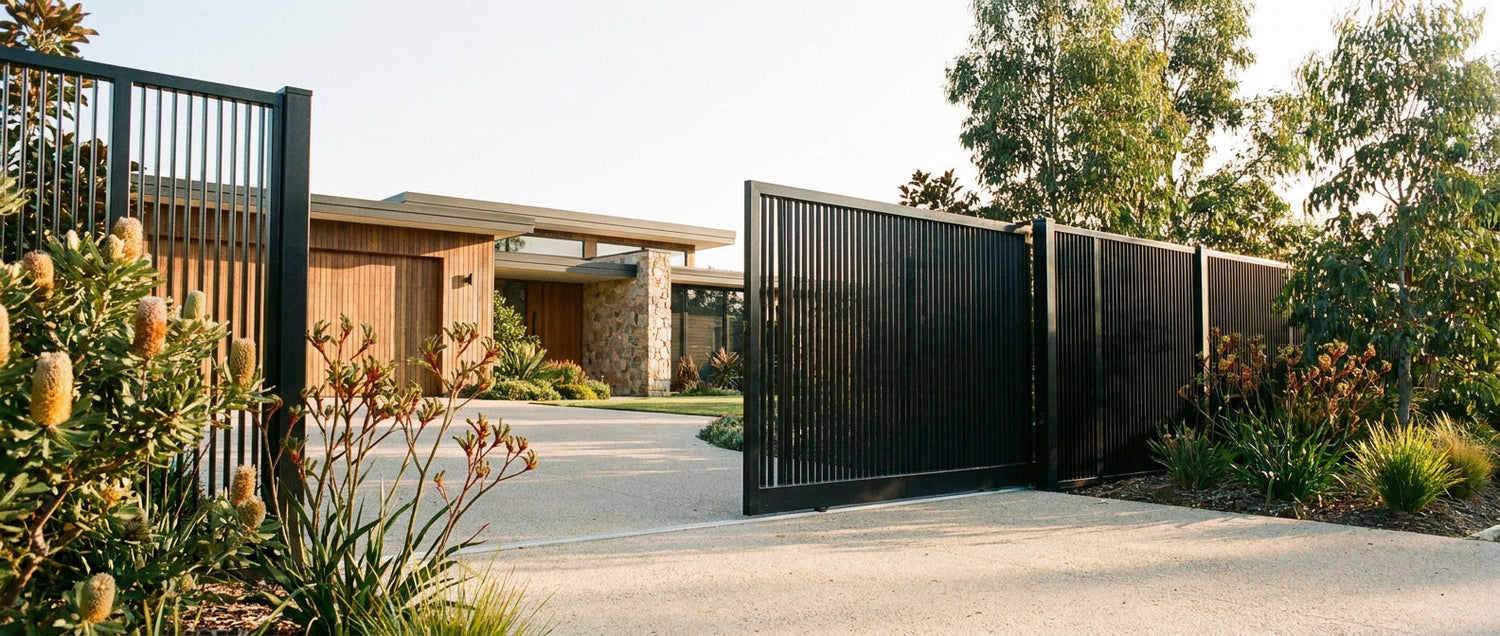
Can Your Existing Gate Be Automated?
The short answer: almost certainly yes. Most existing manual swing gates can be retrofitted with an automation system without replacing the gate itself. The system is essentially a motor working with your existing hinges.
That said, your gate does need to be structurally sound. Walk out and give it a proper look. Check for sagging, rust, warping, or damaged hinges. If the gate drags on the ground or does not swing freely by hand, those issues need fixing first.
You will also need adequate clearance around the gate and its post or pillar for the motor hardware to mount and operate without obstruction. If your gate is in reasonable condition and swings smoothly, automation is well within reach.
The Pre-Purchase Checklist: 5 Things to Measure Before You Buy
Before you start browsing gate automation kits, grab a tape measure. Getting these numbers right upfront saves you from ordering the wrong motor and dealing with returns or costly modifications.
Gate weight is the single most important figure. It directly determines the motor torque you need. A heavier gate demands a more powerful motor, and undersizing leads to premature wear, sluggish operation, and potential safety hazards.
Gate leaf length matters because a longer leaf creates more leverage at the hinge point, increasing the torque demand on the motor. A 4-metre leaf puts significantly more strain on a motor than a 2-metre leaf, even at the same weight.
Swing angle is the full arc your gate travels through when opening. Most residential gates swing 90 to 120 degrees, and this affects which motors are compatible.
Post or pillar dimensions are critical. Measure the width and depth of the structure your gate hangs from. This determines whether a linear or articulated arm motor is the right fit. Swing gates should be mounted on a post size of min 100mm
Hinge placement is the detail most buyers miss. For linear motors, hinges must sit at the back or centre of the post. If your hinges are front-mounted, a linear motor may not work without major modification. The next section explains why.
Finally, check your proximity to mains power. This determines whether a 240V, 24V, or solar-powered system is viable for your property. All of these measurements get cross-referenced against motor specifications to confirm compatibility, so having them on hand before you buy (or before you call us) makes the whole process faster.
Choosing the Right Motor: Linear vs. Articulated Arm
There are two primary motor types for automating swing gates: linear (ram) motors and articulated arm motors. The single most important factor in choosing between them is your post or pillar material and geometry.
Linear (Ram) Motors: Best for Timber or Metal Posts
Linear motors extend and retract in a straight line to push or pull the gate through its arc. They are compact, reliable, and typically the most affordable swing gate motor option, making them widely used across residential and rural properties throughout Australia.
There is a critical geometry rule most buyers miss: linear motors require the gate hinges to be positioned at the back of the post. This is non-negotiable. The straight-line action of the ram only works correctly with rear-mounted hinges. If your hinges sit at the centre or front of the pillar, a linear motor cannot be used without significant modification.
Linear motors are ideal for gates hung on timber or metal posts, where bracket mounting is straightforward and the post material can handle the load. They offer direct, efficient power transfer with no backlash or compliance effects. They are not suitable for brick or masonry pillars, which often lack the structural reinforcement and precise mounting angle required.
Articulated Arm Motors: Best for Brick or Masonry Pillars
Articulated arm motors use a jointed, pincer-like arm that mounts to the pillar face and attaches to the gate leaf. Because the arm pivots at its joint, it can reach around large or wide pillars, pulling a gate up to 300mm from the rear pillar face. That 300mm reach figure is a key compatibility detail that resolves many installation challenges for Australian homes with wide brick columns.
This design makes articulated arms the preferred solution for brick or masonry pillars where linear bracket mounting is not feasible. They mount securely with less structural demand on the pillar itself, which matters when you are unsure about the internal reinforcement of an older brick column.
From a performance standpoint, articulated arm motors are generally more efficient than linear actuators. They tend to offer a greater duty cycle, faster opening speeds, and they place no extra load on your gate's hinges beyond what is needed to move the leaf.
The trade-off is price. Articulated arm motors sit at a higher price point than linear rams. For the suburban brick-pillared homes common across Melbourne, Sydney, and most Australian cities, they are often the only motor type that will work correctly. Spending a little more upfront is far better than discovering your linear motor cannot mount properly after it arrives.
Power Supply Options: 240V, 24V, or Solar?
Your power supply choice should be locked in before you purchase a motor kit, because not all motors support all power options.
240V mains power is the most cost-effective option for typical residential use, comfortably handling low to high usage. If you have a power point or can run cabling to the gate location, this is the straightforward choice.
24V low-voltage systems run cooler and are better suited to higher-frequency use, handling intensive usage. If your gate serves a commercial property, shared driveway, or any high-traffic entry and mains power is not nearby, then 12 or 24V supply is the right call.
Solar with battery backup is ideal for properties without easy mains access near the gate. Modern solar gate systems provide 3 to 5 days of uninterrupted operation without recharging. Solar-power products accounted for 20% of new gate automation releases in 2025, so the range and quality of solar kits has improved significantly.
Access Control: What Can You Connect to Your Automated Gate?
Once your gate is automated, you can integrate a wide range of access control options: remote controls, keypads, WiFi and smartphone apps, intercoms, RFID tags, vehicle loop detectors, and biometric readers.
Smartphone app control via WiFi-enabled control boards is increasingly expected by residential buyers. It lets you open your gate from anywhere, monitor its status, and grant access to visitors remotely. For commercial and industrial properties, vehicle loop detectors and RFID systems handle high-volume access without manual intervention.
Intercom integration is another popular choice, allowing you to manage visitors without leaving the house. Decide on your access control requirements before purchasing. Some motor kits include control boards that support a broader range of integrations than others, and planning this upfront is far easier than retrofitting later.
Ready to Automate? Here's How to Get It Right
The two decisions that matter most are straightforward. First, check your gate's condition and take your measurements. Second, match your motor type to your post or pillar material: linear for timber or metal posts, articulated arm for brick or masonry pillars.
The investment is well worth it. An automated swing gate can increase your property value by up to 5%, and with proper installation and maintenance, most gate motors last 10 to 15 years or more. Annual maintenance is recommended once a system reaches the 5-year mark to keep everything running reliably.
Professional installation ensures safety compliance, correct motor sizing, and full warranty protection. At Powered Gates Australia, we have completed over 2,500 installations since 2015 across Melbourne, Geelong, and the Mornington Peninsula. Every job is backed by our 2-year on-site installation warranty, $10 million AUD public liability insurance, and police and working-with-children checked technicians.
Not sure which motor suits your gate? Send us a photo or upload your site details for a free, no-obligation consultation. You can also reach us via chat or phone for expert advice. As authorised distributors and installers of premium Italian-made brands including BFT, FAAC, Beninca, Centsys, Nice, and Sommer, we will match you with the right system for your property, every time.

Leave a comment
All comments are moderated before being published.
This site is protected by hCaptcha and the hCaptcha Privacy Policy and Terms of Service apply.