
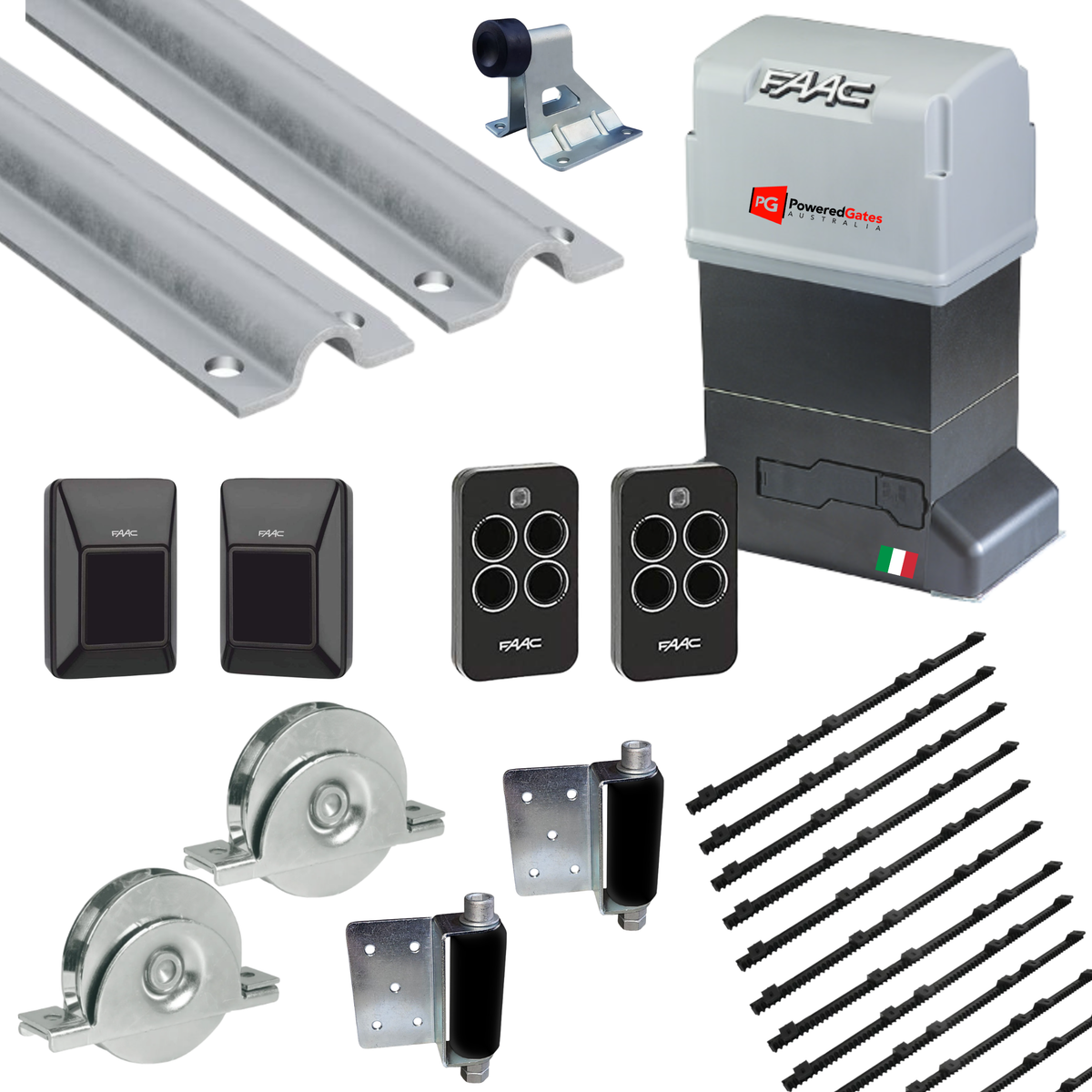
A sliding gate kit combines a motor with the mechanical hardware needed to run a sliding gate: gear rack, gate track, support wheels, and guide rollers. Some kits include everything; others bundle the motor with key hardware and leave consumables like concrete anchors and cabling to the installer. Before you buy, you need to know three things: your gate's width, its weight, and how many times a day it opens and closes.
What Does a Sliding Gate Kit Include?
A kit is not a motor; that's the first thing to get straight. A motor is the operator, the unit that drives the gate open and closed and a kit is the motor plus the mechanical hardware required to actually run the gate along its track.
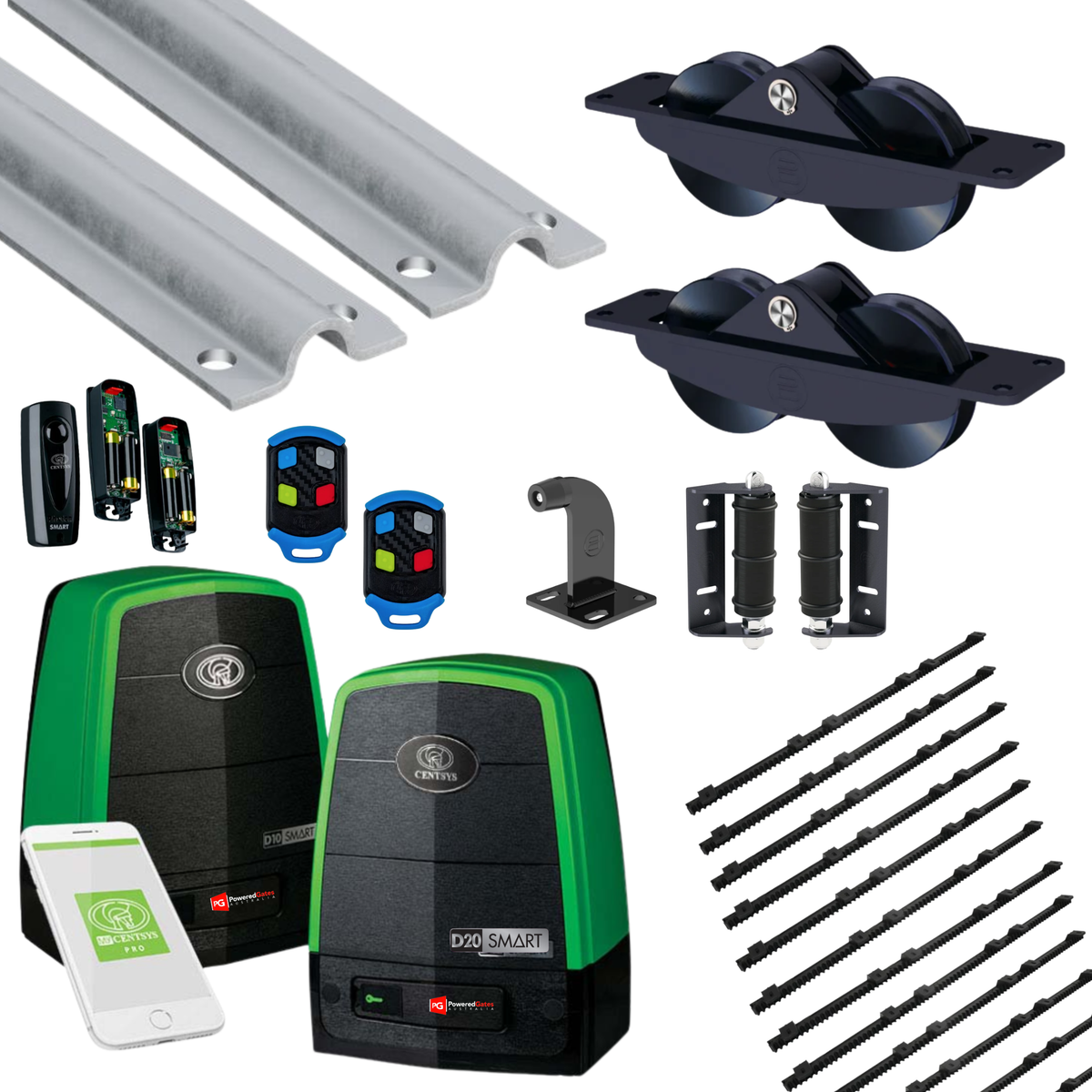
Every Powered Gates Australia motor and hardware kit includes:
- Motor/operator — the drive unit (Centsys, BFT, FAAC or Beninca depending on the kit)
- Gear rack — the toothed strip fixed to the bottom of the gate that the motor pinion drives against
- Gate track — the ground-level rail the gate wheels run on
- Support wheels — carry the gate's weight as it travels; single or double bearing depending on the kit grade
- Guide rollers — keep the gate running straight and prevent lateral movement
Most residential kits also include one or two remote controls. Access control beyond that, such as RFID readers, keypads, intercoms, loop detectors, is not included in any standard kit.
What is NOT included in any kit:
- Concrete for the motor pad (every motor requires a concrete slab or pad for mounting)
- Electrical cable from your power supply to the motor
- Conduit for cable protection
- Post brackets (varies by installation)
- The gate frame itself (kits include the hardware to run the gate, not the gate)
This is information that changes your budget and your timeline. If you're planning a new installation, get the concrete and electrical work scheduled before the kit arrives.
| Component | Residential Kit | Commercial Bundle | Industrial Bundle |
|---|---|---|---|
| Motor/operator | Up to 400 kg rated | Up to 800 kg rated | 800 kg+ rated |
| Gear rack | Standard nylon | Steel-core nylon | Steel-core nylon |
| Gate track | Standard | Heavy duty | Heavy duty |
| Support wheels | Single bearing, standard | Double bearing | BOSS double rebate bearing (Centsys) / IBFM 140mm dual bearing (FAAC) |
| Guide rollers | Standard | Reinforced | Reinforced |
| Remotes | 1–2 included | 1–2 included | Confirm per product |
| Concrete pad | Not included | Not included | Not included |
| Electrical cable | Not included | Not included | Not included |
| Gate frame | Not included | Not included | Not included |
The Difference Between Residential, Commercial and Industrial Kits
The motor voltage and weight rating on the box can look fine and the gate opens like it should. But six months later, the wheels develop lateral play, the gate rides off the track and the motor overworks to compensate.
The problem isn't the motor; it's the hardware grade. Every component in a kit must match the gate's weight and the site's daily cycle count.
- Residential kits are built for home driveways and light-commercial entries. Gates up to 400 kg, standard nylon gear rack, single-bearing wheels, up to around 100 cycles per day. They're well-suited to what they're designed for. Put one on a school entrance or a warehouse loading dock and it's out of its depth within months.
- Commercial bundles step up to gates in the 400–800 kg range with reinforced hardware, such as heavier gear rack, double-bearing wheels and heavier track. These are the right choice for schools, strata complexes, office parks, and light industrial sites where the gate's working harder than a residential installation but not at full industrial load.
- Industrial bundles are a different category. The motors are rated from 800 kg to 2,000 kg. The gear rack is steel-core nylon. The wheel sets are BOSS Double Rebate Bearing wheels (Centsys bundles) or IBFM 140mm recessed dual-bearing wheels (FAAC 844 bundle). These are the same hardware commercial gate fabricators spec on new builds for a reason: they hold their geometry under sustained heavy load without developing the lateral play that causes gates to derail.
If your gate is over 800 kg, or your site opens and closes more than 500 times a day, you're in industrial territory, so don't spec down.
Need a kit for a gate over 800 kg?
How to Choose the Right Motor for Your Gate
Get these three measurements right and the motor selection is straightforward.
Gate width (post to post)
Measure from the closed post to the open post, then add the clearance your motor mounting requires. This gives you the opening width the motor needs to clear. Residential gates run up to 5 m. Commercial gates up to 9 m. Industrial bundles handle openings up to 15 m.
Gate weight
If your gate fabricator can tell you the weight, use that figure. If not, calculate it: steel runs approximately 15–25 kg per metre of gate length depending on the section profile; aluminium runs lower. A 6 m steel sliding gate can easily sit between 180 kg and 400 kg depending on the frame design. If you're not sure, ask your fabricator, because getting this wrong means buying the wrong motor.
Daily cycle count
Count every user across a full day, multiply by 2 for open and close. A household with four drivers running the gate twice each direction is 16 cycles; a warehouse entry used by 40 vehicles a day is 80 cycles minimum; a school with buses, parents, and staff at drop-off and pick-up can hit 300–500 cycles on peak days.
| Gate Weight | Gate Width | Daily Cycles | Recommended Category |
|---|---|---|---|
| Up to 400 kg | Up to 5 m | Up to 100 | Residential kit |
| 400–800 kg | Up to 9 m | 100–500 | Commercial bundle |
| 800 kg+ | Up to 15 m | 500+ | Industrial bundle — Centsys D10/D20 or FAAC 844 |
Browse all sliding gate kits and bundles →
Gear Rack Types: What You Need to Know
The gear rack is the toothed strip fixed along the base of your gate. The motor's pinion gear drives against it to move the gate and choosing the wrong rack type on a heavy or high-cycle gate is one of the most common reasons motors fail prematurely.
- Standard nylon gear rack is fine for residential gates with light to moderate use. It's quiet, cost-effective, and straightforward to install. Under sustained heavy load or high cycle rates, nylon rack wears faster and can crack under impact.
- Steel-core nylon gear rack is the commercial and industrial standard. The nylon outer profile runs quietly against the motor pinion. The steel core handles the structural load. Under a 1,000 kg gate running 500+ cycles a day, this is the minimum specification.
- Rack pitch (M4 vs M6) refers to the tooth spacing. M4 pitch (4 mm between teeth) is standard for residential and light-commercial motors. M6 pitch (6 mm) is used on heavier commercial and industrial motors that require more contact surface per tooth to handle the load. The motor pinion and rack pitch must match; fitting an M4 rack to an M6 pinion will cause poor engagement and rapid wear. Every PGA bundle includes the correct rack pitch for the bundled motor.
All Powered Gates Australia industrial bundles include steel-core nylon gear rack matched to the motor's pinion specification.
Gate Wheels and Hardware Grades
The wheels are what the gate rides on. Everything else being equal, the wheel set determines how long the installation runs cleanly before it needs attention.
- Single-bearing wheels handle lighter gates with lower cycle rates. Standard residential hardware across the industry.
- Double-bearing wheels are the step up. Two bearings per wheel absorb the load more evenly, resist lateral play developing over time, and handle higher cycle rates without the wheel housing deforming. Once a gate develops significant lateral play, realignment or full hardware replacement is the only fix.
- BOSS Double Rebate Bearing Gate Wheels (supplied in Centsys D10 and D20 bundles) are heavy-duty double-bearing wheels rated for commercial and industrial loads. The rebate profile sits within a standard steel gate track and keeps the gate geometry stable under high-cycle use.
- IBFM 140mm Recessed Dual-Bearing Wheels (supplied in the FAAC 844 bundle) are Italian-made dual-bearing wheels with a recessed profile suited to concrete or paved entries. IBFM is a commercial-grade hardware brand used by gate fabricators across Europe and Australia.
The point of specifying these hardware brands is to tell you that the bundle is matched. A BOSS or IBFM wheel set paired with the right motor handles the load and cycle rate the motor is rated for. A generic wheel set on the same motor might look identical on day one and fail within 18 months under the same load.
Telescopic and Cantilever Gate Kits: When Do You Need Them?
Telescopic sliding gate kits use a two-panel gate design where both panels stack behind the post when the gate opens. The result: the gate needs half the run-back space of a comparable single-panel gate. If your driveway has a structure, fence, or boundary within 4–5 m of the post, a telescopic kit is often the only practical configuration.
The Powered Gates Australia telescopic sliding gate kit is one of the site's most popular kits for exactly this reason. If run-back space is tight, start here.
Cantilever gate kits suspend the gate from upper and lower rollers on the post side, with no track in the ground. The gate hangs rather than rolls on the ground. This suits uneven surfaces, gravel driveways where a ground track would collect debris and jam, or any site where cutting a track into an existing paved surface isn't practical.
Standard ground-track kits that usually include the motor, ground track, support wheels and guide rollers are the most common configuration for flat driveways and commercial entries with a clean, level run.
Professional-Grade Kits vs Hardware Store Options
Bunnings stocks sliding gate kits. They're designed for light residential use, and for that application, they do what they're sold to do.
The difference between a hardware store kit and a PGA bundle is not price-point snobbery. It's specification matching. PGA bundles pair Italian-made BFT, FAAC and Beninca motors and South African-made Centsys motors with hardware that is rated for that motor's weight and cycle capacity. The BOSS and IBFM wheel sets aren't included because they're premium; they're included because they're the correct specification for the motor they're paired with.
A hardware store kit at $400 makes complete sense for a light residential gate that opens 20 times a day. The same kit on a commercial entry opening 200 times a day is a different calculation entirely. The kit price is the cost of replacement hardware, downtime, and a service call 12 months later.
If you're buying for a home with a standard residential gate, a hardware store kit may well be the right call. If you're buying for a commercial or industrial site, or a gate over 400 kg, spec it correctly from the start.
What Do You Still Need to Source Separately?
- Concrete for the motor pad. Every sliding gate motor mounts on a concrete pad or slab. The pad size and depth depend on the motor weight and soil conditions; your installer or the motor installation guide will specify the dimensions. It is not included in any kit.
- Electrical cable and conduit. The cable run from your power supply to the motor needs to be planned, quoted, and installed before the motor arrives. For 24V DC motors, the low-voltage connection is generally DIY-capable in most Australian states. Check your state's electrical regulations before proceeding. For 240V AC motors (FAAC 844), a licenced electrician is required in all Australian states. No exceptions.
- Access control beyond remotes. Standard kits include one or two remotes. RFID card readers, pin-pad keypads, video intercoms, and induction loop detectors are separate purchases. If your site requires any of these, plan them alongside the kit purchase.
- The gate frame. Kits include everything needed to run the gate. They do not include the gate. The gate frame is manufactured or purchased separately and is on the site before installation begins.
Our team can confirm what your specific site needs before you order. Get in touch here.
Frequently Asked Questions
What is the difference between a sliding gate kit and a sliding gate motor?+
A motor is the operator and the unit that drives the gate. A kit includes the motor plus the mechanical hardware needed to run the gate: gear rack, gate track, support wheels, and guide rollers. Buying a motor without matched hardware means sourcing those components separately, without the guarantee they're rated for the motor you've chosen.
Can I install a sliding gate kit myself?+
The hardware installation is within reach for an experienced DIYer. The electrical connection depends on the motor voltage. For 24V DC motors, the low-voltage connection is generally DIY-capable in most Australian states, though always check your state's current electrical regulations. For 240V mains motors (FAAC 844), a licenced electrician is required in all Australian states, no exceptions.
How much does a complete sliding gate kit cost in Australia?+
Residential kits start from around $1,380. Commercial bundles start from approximately $1,430 depending on motor rating and hardware grade. Industrial bundles start from $2,200 upward. Browse the full range for current pricing; all kits include free shipping on orders over $1,499.
What gate width does a standard sliding gate kit handle?+
Residential kits suit openings up to 5 m. Commercial bundles handle up to 9 m. Industrial bundles cover openings up to 15 m. Width is one of three measurements needed to select the right kit, and gate weight and daily cycle count are the other two.
What is a telescopic sliding gate kit?+
A telescopic kit uses a two-panel gate design. Both panels stack behind the post when the gate opens, so the gate only needs half the run-back space of a single-panel gate covering the same opening width. It's the standard solution for driveways where limited clearance behind the post makes a single-panel gate impractical.
Do I need a concrete pad for a sliding gate motor?+
Yes. Every sliding gate motor requires a concrete pad or slab for the motor mounting point. The pad dimensions depend on the motor model and soil conditions; your motor's installation guide specifies the requirements. Concrete work needs to be completed and cured before the motor is installed, so schedule it before the kit arrives.
Get professional installation across Melbourne; full supply and fit available.

Leave a comment
All comments are moderated before being published.
This site is protected by hCaptcha and the hCaptcha Privacy Policy and Terms of Service apply.